
State of the Union 2026: the second leg of the AI race and new social media rules for minors
This year's State of the Union address by the President of the European Commission, Ursula von der Leyen, focused on three topics related to the digital policy - AI, social media use for minors, and briefly, addictive design and the upcoming Digital Fairness Act.
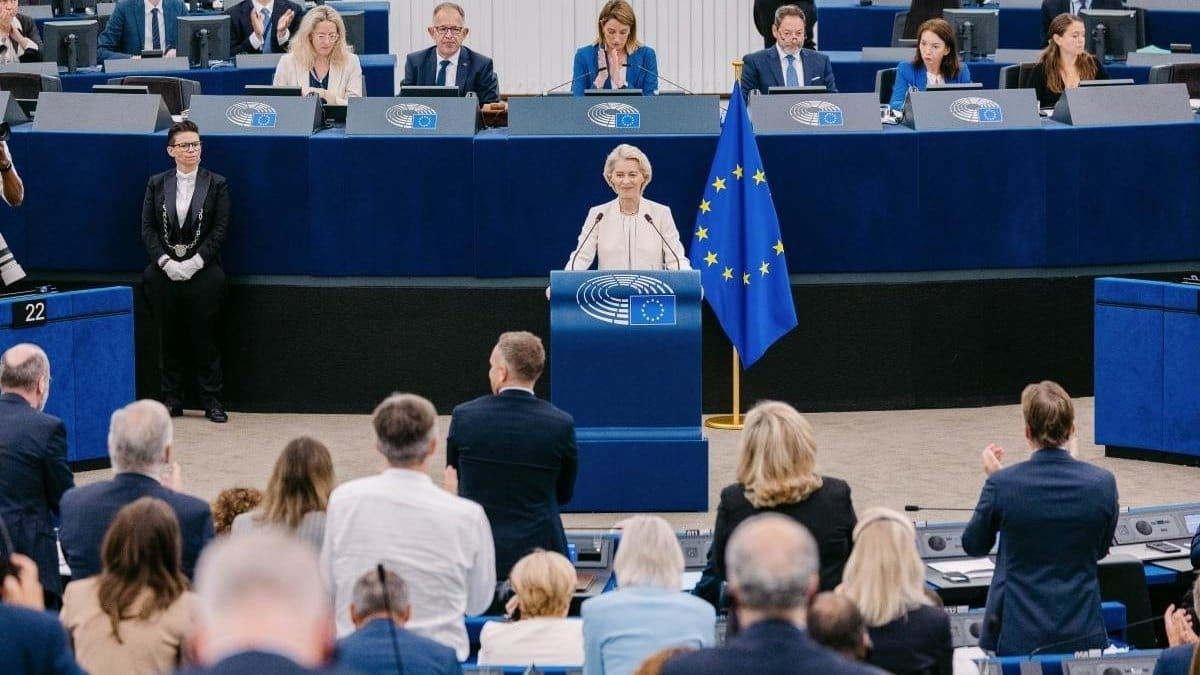
The three digital policy-relevant topics the President of the European Commission mentioned today at her State of the Union address were the EU's ambition in artificial intelligence (application, as well as pacing the AI frontier models), new proposals for the use of social media for minors through the Kids Act, and the short mention of the upcoming Digital Fairness Act.
"Europe doesn’t need its own frontier models to benefit from AI"
An important and sober message in Ursula von der Leyen’s address today was that the EU can benefit from AI frontier technology even if it doesn’t have its own. The European industrial base, coupled with the new push for open-weight models among the leading US frontier AI companies, offers many opportunities to increase labor productivity and find new economic opportunities.
“We do not need to be the ones who develop the frontier technology to be the ones who draw the greatest value from it. The key is creating the value that AI has not yet delivered. Moving AI from the screen to the real economy and society. On the factory floor. On the hospital ward. In precision agriculture. In our energy grids. For autonomous driving. For defence. This is where the real value is hidden. And it is where Europe has big advantages. We have world-class industries that sit on the highest-quality data. These data are a precious European treasure. They are what can power tailor-made industrial AI models.”
The President of the EU Commission later mentioned that the EU will focus on five sectors: health, transport, agri-food, advanced manufacturing, defense, and space, where new EU calls will be announced in November 2026.
The second leg of the AI-race is on, while the decisions on data availability are not
As much as one could agree with von der Leyen’s statement that the second race of the AI race - AI application - is important now, the issue of data availability for AI remains a big roadblock for European innovators. Many startup founders, as well as representatives of more mature companies, continue to emphasize the importance of data availability for developing local AI applications.
The EU Commission has indeed proposed reasonable solutions in its Digital Omnibus proposals back in 2025, such as changes to the definition of personal data after it has been sufficiently pseudonymized, as well as recognizing AI development as a legitimate basis for using personal data under the General Data Protection Regulation (GDPR).
However, the proposals received pushback at both the member state and European Parliament levels. In the meantime, the negotiations on the proposals are in political limbo, since critics have also questioned the Irish Presidency's capacity to lead the negotiations, citing its dependence on foreign tech companies based in Ireland.
It’s worth noting that the EU has outlined initiatives such as the Common European Data Spaces to simplify access to data; however, given that the latest status updates on the initiative date back to 2024, the real impact remains limited.
Pacing the AI frontier models: cybersecurity risks & impact on jobs
Anthropic Dario Amodei’s calls to slow down the AI development were not left unnoticed by the head of the European Commission. She used the argument to support the European careful approach to AI by stating that “CEOs of the most advanced companies tell us that it is time to slow down on the self-recursive models. To pace the frontier.”
The President’s statements on AI have, of course, focused much on the risks of AI and the need to address them: from AI-related cybersecurity incidents to AI potentially posing a risk to jobs, especially entry-level jobs important to young people.
While the EU Commission’s President highlighted the positive impacts of AI on the economy, such as improved productivity by speeding up repetitive tasks, she quickly turned to the claim that these skills are “unevenly spread between skill sets, generations, and regions”. She then turned to stating that young people are facing barriers to entry-level jobs due to AI, and mentioned the upcoming Quality Jobs Act, which is likely to address the impact of AI on the European workforce.
AI literacy and AI-reskilling pace are indeed unevenly distributed across the EU - according to the data from 2025, 25% of Finns used AI for work purposes, compared to 1,31% Hungarians. Meanwhile, while some EU member state governments are still working on their AI for education strategies, Estonia is outpacing many - leveraging AI to not only equip their schoolchildren with much-needed skills, but also use AI to help develop critical thinking skills.
Social media and minors - the Kids Online Act & the Digital Fairness Act
As expected, Ursula von der Leyen talked extensively about minors on social media and, following the July recommendations of the Special Panel of experts, announced the EU Kids Act.
According to the leaked Act's version, anyone under the age of 13 will be banned from using social media altogether, teenagers aged 13-14 will get access to accounts supervised by parents, 15-17 year-olds will have access to social media, but social media platforms will have to implement new safe design measures.
Lastly, the President hinted at the Digital Fairness Act, which is expected to be proposed very soon and, among other things, will address issues of addictive design for a broader set of Europeans.


