
A technorealistic approach to AI literacy in Estonian schools
As European governments discuss the ethical use of AI in education and plan budgets to facilitate AI literacy among students, the Estonian AI Leap approach stands out as highly pragmatic and thoughtful.

Anyone over the age of 30 has heard at least one business manager, entrepreneur, or university professor complain that the younger generation is remarkably AI-savvy and quick to complete tasks with AI, yet young people are often unable to adequately question, think through, or explain the outputs they receive.
The concept of human oversight is also still a highly abstract idea - what is a proper human oversight? How do we teach that? Without strong foundations for critical thinking, AI tools risk amplifying issues already present in many societies, where people believe everything they read. Previously, this over-reliance applied to traditional media, later to social media, and now to chatbots and various AI tools. As a result, a lack of critical thinking is making both individuals and whole societies more vulnerable to various external threats, while employees who use AI lazily are exposing their workplaces to not only commercial and reputational threats but also legal consequences.
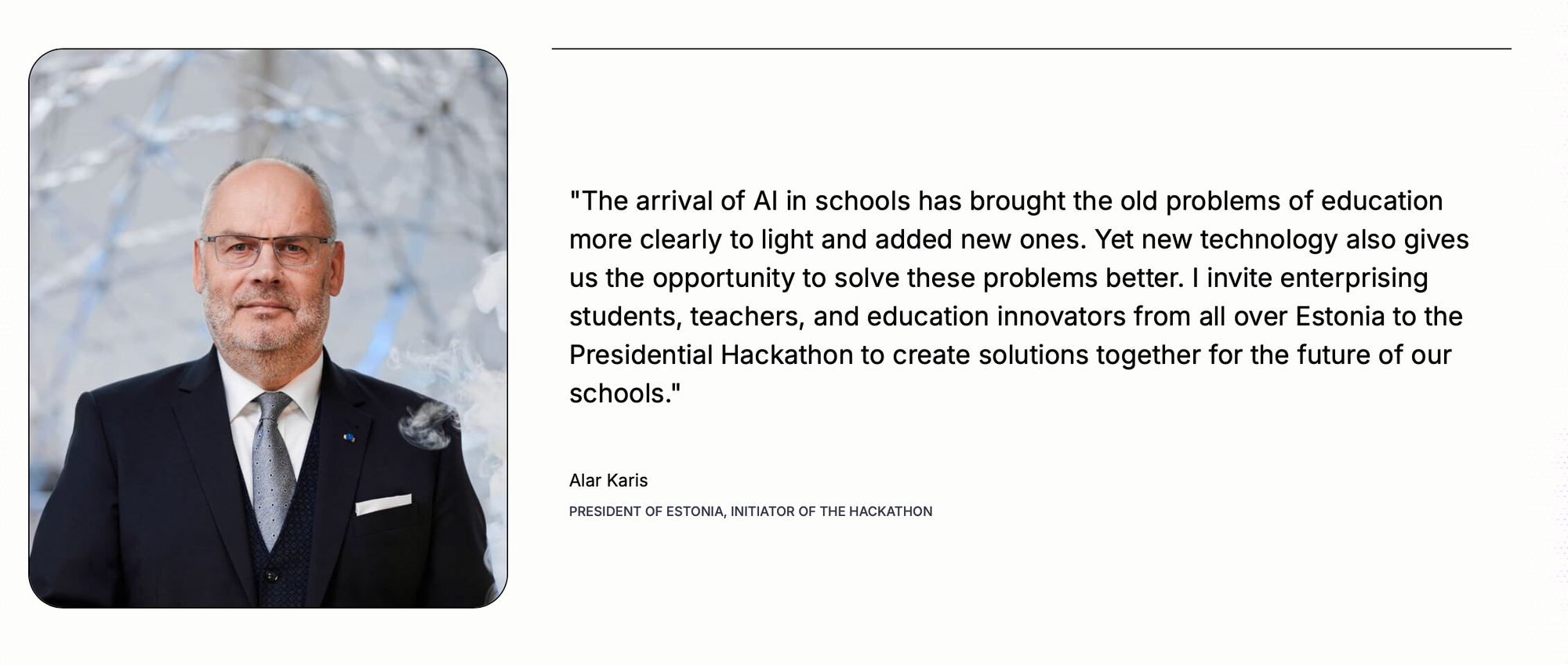
Currently, European governments have two options on the table: either they engage with both the opportunities and threats of AI tools passively (focusing on soft-format lecturing on ethical considerations, threats, and more), or they go head-on and use the AI tools to steer students in the right direction, raising young adults who are not only AI literate but also critical thinkers.
The Estonian approach to AI literacy in schools - the AI Leap program - is an extremely interesting case that many other countries could learn from and replicate. Instead of trying to achieve the impossible - shielding the younger generation from AI exposure for as long as possible (while they are, in the meantime, actively and often irresponsibly using AI tools anyway) - the Estonians are using the most advanced AI tools to not only develop AI skills, but also to empower teachers and nurture critical thinkers while they are still at school.
Estonian AI Leap: goals, scope, and tools
The Estonian AI Leap website says that even before the start of the AI Leap program, “64–90% of Estonian students were using AI tools,” which, in the program founders’ opinion, could be hindering students' thinking and learning skills if left as is.
Europe’s good and bad experiences with various digital skills projects have taught everyone one thing: if a skills program is not big and engaging enough, the impact is limited. The AI Leap’s scope is ambitious in the context of Estonia’s 1.36 million population: over 2 years, Estonia will train 48.000 students and 6700 teachers.
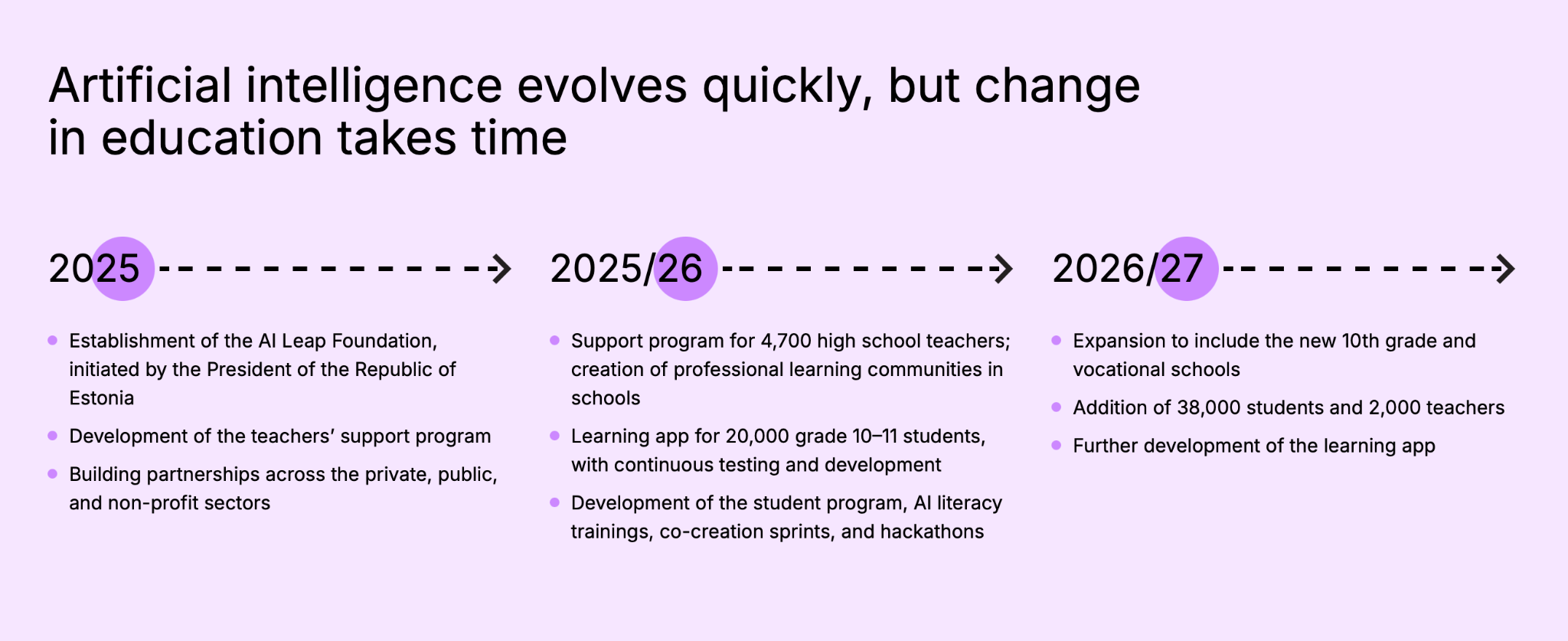
The goals of Estonian AI leap are twofold: first, to transform teaching practices by empowering teachers as the primary guides for students, by giving them access to the most advanced tools, providing targeted tutoring, resource platforms and making them co-creators of the new system. The second long term goal is to transform student habits, anchoring them in critical thinking and prevent lazy AI use. Overall, the program relies on 5 main tools:
- Study circles - professional learning communities for teachers that meet 1–2 times a month, aimed at helping teachers find and co-create new teaching strategies and tactics.
- Centralized online resource platform - with videos, reading materials, self-assessment tests, and an interactive forum to facilitate communities, collaboration, share thoughts on educational psychology and best practices.
- Give access to the most advanced AI tools - Estonia will grant 4000+ teachers premium access to the most advanced AI tools, such as ChatGPT and Gemini to help with lesson planning.
- Socratic AI chatbot - a tailored chatbot designed to guide students rather than provide direct answers. The chatbot will encourage self-management, persistence, critical thinking, training students to question AI outputs and contextualize complex concepts.
- Non-formal engagement - various non-formal formats for students that promote immersive settings, like micro-companies, creative arts circles, debate leagues, and more.
Management: often overlooked, but important for lasting success
Good strategies and ambitions often die in the implementation phase, due to poor management structures. Estonian AI Leap bypasses this with a plan that recognizes local peculiarities and limitations. The strategy is built on constant monitoring, self-assessment, and the freedom to pivot if things fail.
The organizational part of the AI leap program has 4 general directions:
- The school level - where school principals lead the program and are responsible for implementation, teacher engagement and results.
- The regional level - Estonia is mapped into 7 distinct educational regions that are led by 9 regional managers, whose responsibility is to coordinate seminars and various online and offline meetings across regional schools. This approach is important to most European countries - different regions and municipalities have varying levels of digital literacy, financial means and more. Oftentimes, the big cities are highly advanced, while the smaller ones are left to figure things out themselves.
- Public-private partnership - Estonia is making the most of different worlds, where the Ministry of Education and the AI Advisory Council collaborate with the AI Leap foundation and various entrepreneurs. Launching a specialized think tank is a smart operational approach, given that Ministries of Education and schools have neither the know-how in AI and psychology, nor the freedom and resources to experiment. The AI leap program is funded through a public-private partnership model: the Estonian state contributes 50% of the necessary funds, and the remaining 50% comes from the private sector. This allows local and foreign businesses to give back to the community, while also giving them a platform to explore practical solutions to issues raised by various techno pessimists. The leading partners such as Telia, Targa Tuleviku Fond, Skaala contribute €25,000 / €50,000 / €100,000+. Big-tech wise, OpenAI and Google partner with Estonia to build and localise custom educational tools.
- Engaging student organizations - engaging youth organizations such as debate leagues, student councils and more.
What the European Ministries of Education should not do
Avoid vendor lock-in & simplistic approach. The worst-case scenario for the EU's Ministries of Education would be to buy premium licenses for one AI tool, effectively vendor-locking themselves into it, while failing to provide additional, continuous, and engaging support for teachers, including psychology-related materials. This is an especially critical now as the EU countries prepare and plan for the new EU budget. The Estonian approach to mixing and matching different AI tools, creating resource platforms, facilitating various other formats will prove to be a more effective approach .
Prioritize active practise. An equally wrong approach would be for Ministries of Education to focus on providing AI tools for teachers and pupils, while failing to do their own, localized homework about AI usage. Relying on various guidelines issued by the European Commission and position papers by the Council of the EU, as well as occasional lectures about the dangers of AI are not sufficient - the best learning comes from practice. Estonia solves this through custom-made AI chatbots and various interactive formats.
Integrate across disciplines. Limiting AI literacy classes to informatics/computer science classes only would also be a bad approach. AI is already multidisciplinary, and learning has to be fun, especially learning to become critical thinkers. Estonia solves this by creating various formats where students can use and discuss AI - from debate leagues to art classes, custom chatbots, and more.
Ensure good management. The management part is especially important - oftentimes in Europe, strategies are launched and publicly celebrated, while the management and oversight are left to solve themselves. For strategies to be actually effective, they have to be living organisms which engage different experts and recognize various differences between pupils, teachers, schools, and districts and... are continuously monitored and adapted.
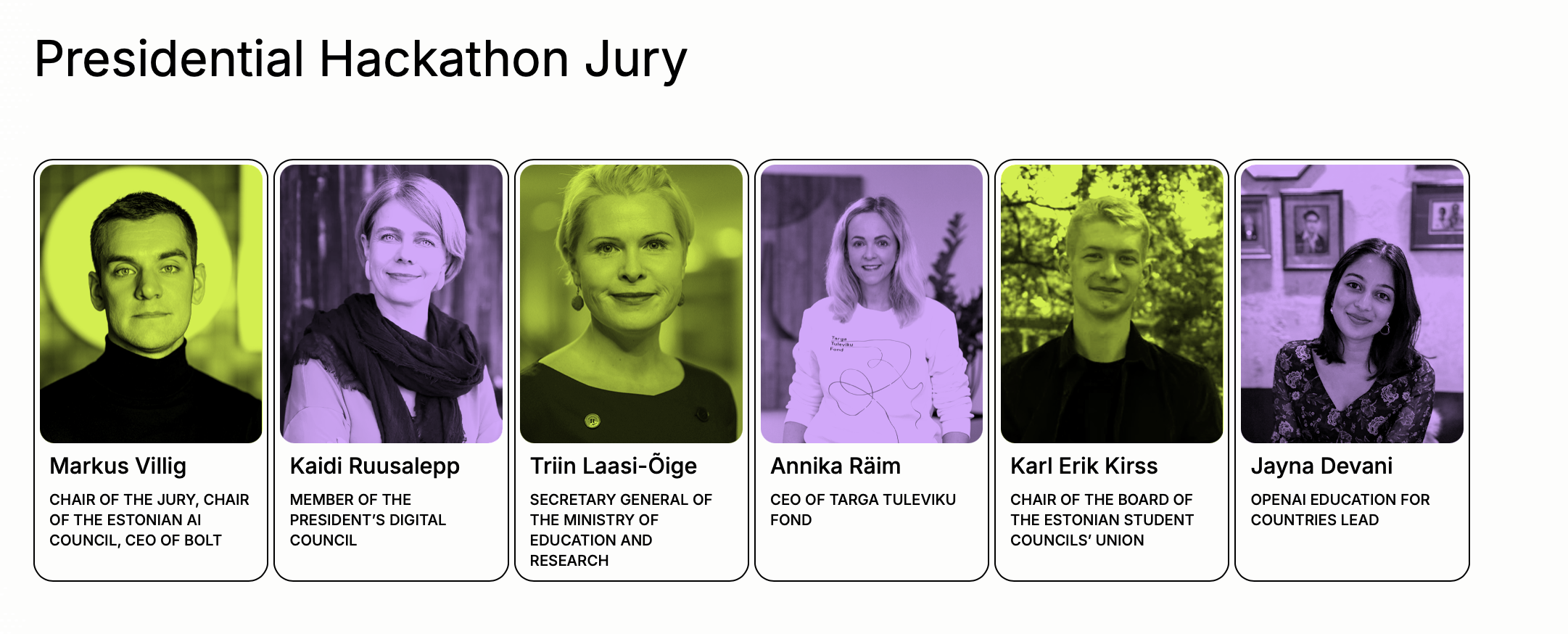
Engage external experts. An important matter is staying humble - instead of getting stuck in the “we know better” or “here's the strategy, now you implement it” approach, Ministries of Education have to engage a wide set of experts - from private companies to psychologists and researchers. Estonia also includes local thought leaders such as tech CEOs, experts, and founders as hackathon mentors, ensuring everyone engages in a joint effort.
Address socioeconomic gaps. The differences among students must also be taken into account. Not everyone has the means to use AI tools at home, nor is everyone born into families who have the same approach to raising children. AI literacy programs must recognize deep differences in socioeconomic means and learning capacities and plan accordingly.
View it as an opportunity to transform education itself. Ministries of Education and governments must view AI literacy programs not as ends in themselves, but as a way to tackle a long-standing problem in many schools, where instead of nurturing critical thinkers, systems often end up mass-producing students motivated only by grades and immediate results. AI should not be seen as an obstacle and something to fight, but as a new opportunity to transform educational systems and teaching methods using the very tools that students naturally lean towards.


