
The EU’s DMA: fines, delayed features and unclear benefits
Apple’s Siri AI delay has turned the DMA from a Brussels bubble debate into a consumer issue: the DMA is meant to ensure a fair market, but what are the measurable benefits for consumers and founders?

Apple’s announcement that its Siri AI will be delayed in the European Union due to the Digital Markets Act (DMA) has visibly irritated the European Commission.
A growing number of tech companies are choosing to delay or entirely withhold features and services in the EU, while the tech policy debate is gradually being brought out of the Brussels bubble and onto the radar of consumers and local politicians. For instance, last year’s decision by META and Google to restrict political ads as a response to the EU’s Regulation on the Transparency and Targeting of Political Advertising (TTPA) has already brought dissatisfaction among politicians and non-governmental organizations alike.
“The EU will not give any exemptions, just like a police officer would not exempt the driver from respecting a speed limit”
The EU Commission’s spokesperson's tone and message on the subject at the recent press conference deserves to be quoted fully:
“We have to set the record straight. The decision not to allow Siri AI is Apple’s and Apple’s only. Because absolutely nothing in the DMA prohibits Apple from introducing new products in the EU. What Apple, however, is not allowed to do, just like any other gatekeeper, is to close the market. It is not for them to decide who gets to innovate in Europe and it’s not for them to choose which AI tools our EU citizens get to use or not. That’s precisely what the DMA and its interoperability obligation comes in. Because if we want to innovate, and to have innovative solutions, and more choices for our users, we need fair and open competition between our developers. Now you mention Siri AI, what is the true story behind that. We had a few contacts with Apple on this matter, this I can confirm, but Apple was simply unable to develop interoperability solutions that meet the essential EU privacy and security standards. Instead of trying to find a suitable compliance solution, Apple simply made a request to the European Commission to be exempted from their interoperability obligations under the DMA. And this, for at least 18 months, on top of it. Guess what, that’s not an option. Because that would mean that no other AI agent, except for Siri AI, by the way, powered by Google, would have an equal chance to be chosen by iPhone users. <...> And more importantly, EU law is non-negotiable, the EU will not give any exemptions, just like a police officer would not exempt the driver from respecting a speed limit”.
Comparing the DMA to driving rules was probably meant to satisfy the demand for a “clapback” from the Brussels bubble, but the logic behind it is unclear. Driving rules provide clear, fixed rules for behavior, whereas the DMA relies on a dynamic set of measures from the EC’s side that many tech giants have described as a system of “moving goalposts”.
Gatekeepers are indeed given ex-ante obligations in the DMA (e.g., interoperability, user access to their own data vs. refraining from self-preferencing), but the practical implementation and evaluation of tech giants’ proposed solutions are ambiguous, based on continuous, flexible evaluation by the Commission. In theory, the Commission has a vast toolkit for moving these goalposts:
“As DMA enforcer, the Commission can adopt non-compliance decisions, it performs market investigations to determine infringements, if necessary update gatekeepers' obligations (by way of implementing acts) and design measures to tackle systematic infringements of the DMA's rules. It can request information from gatekeepers, and access to any data and algorithms, including through interviews or onsite inspections. In urgent cases, it has the power to order interim measures against gatekeepers.”
Examining DMA benefits for consumers and founders
Many smaller startups, scaleups, and founders are critical of big companies - be it big auto, big pharma, big food, or big tech. They often point to unfair contractual practices, which prevent them from getting access to their platforms (e.g., a game app wanting to be featured in an App Store) or buying data that is needed to develop their own product (e.g., a data startup wanting to buy data on vehicles from, say, Mercedes).
For this reason, legislation such as the Data Act or the Digital Markets Act was created. The universal principle of intentions not always resulting in tangible benefits applies here, too.
The Data Act, among other things, was meant to entrench fairer rules on data exchange - for example, to prevent data holders from using unfair contractual practices to block smaller players from accessing or purchasing the data they need. The legislation became applicable only in 2025 and is already subject to changes following the EU’s Data Union Strategy. No mature evidence is available yet, so we can only rely on ad hoc impressions from smaller companies. These companies often remain critical of the Data Act’s impact: while the rules exist on paper, the practical reality is different - very few growth-oriented companies are willing to challenge larger companies, especially European ones, and risk creating bad blood for future cooperation.
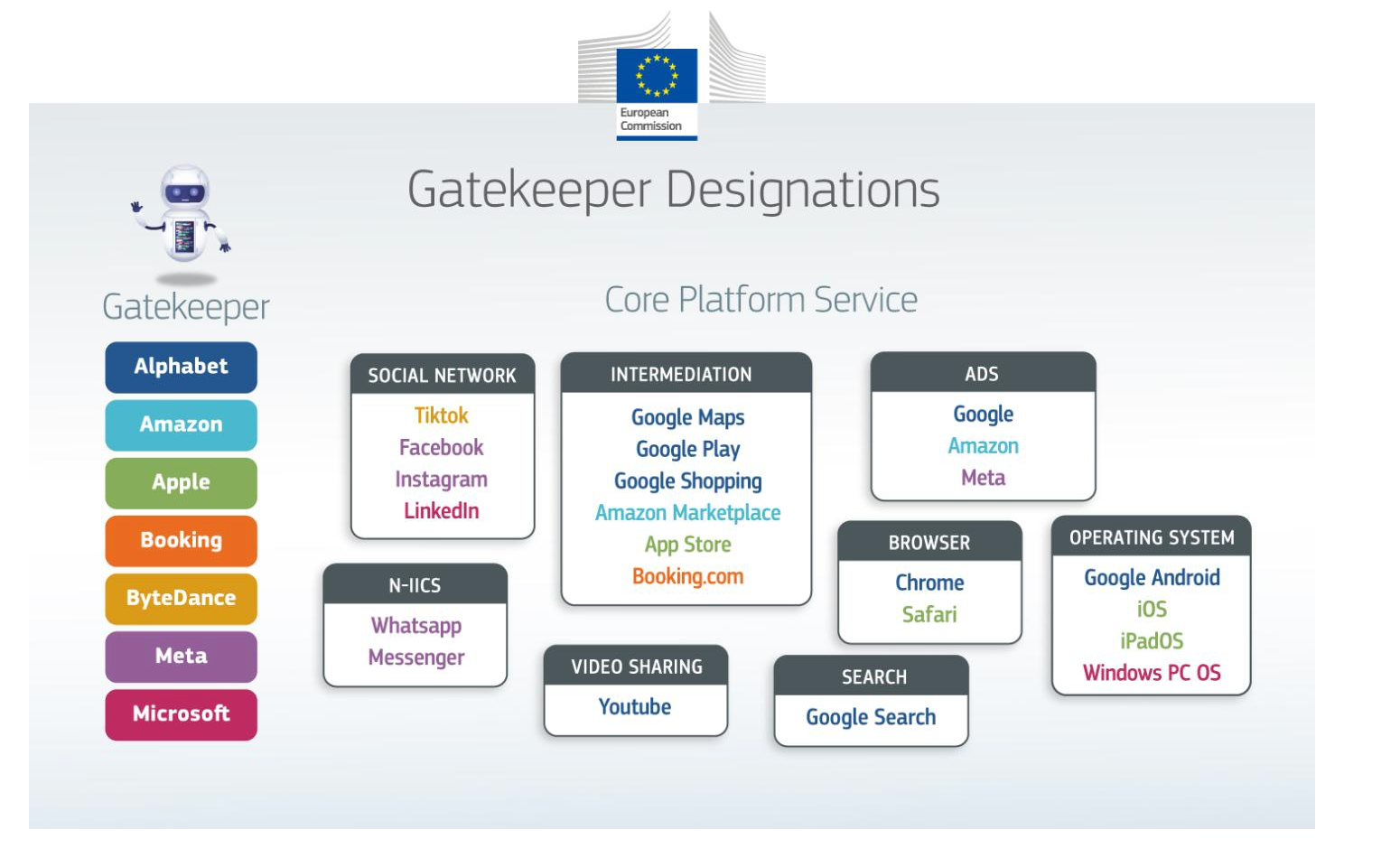
The conversation about the Digital Markets Act (DMA) and designated gatekeepers, however, is less cautious, as most designated gatekeepers come from outside the EU - with the exception of Dutch-based Booking[.]com.
With the DMA, EU politicians sometimes openly celebrate fines imposed on US-based tech companies (See Picture below), while the European Commission itself even Freudian-slips into presenting the DMA as part of its tech sovereignty toolbox, while simultaneously rejecting US accusations that the DMA discriminates against US companies, first and foremost.

Tech sovereignty and the “showing them” sentiment aside, what are the actual benefits of the DMA for European consumers and founders? Has the DMA achieved its intended results since 2023? Are there any economic benefits that would be easy to track?
The European Commission has recently published a three-year review of the DMA, evaluating whether its objectives are reflected in results that create a fairer market, including for founders, SMEs, and consumers. As expected, the assessment says that the direction is good, the gatekeeper behavior is changing, but that more enforcement is needed.
The 83-page Staff Working Document does not appear to rest on hard economic figures or a quantified cost-benefit assessment. Instead, it is based on a broad evidentiary record, while acknowledging that some of the DMA’s impacts remain not fully observable. Interestingly, the word “economic” appears only 6 times in the whole document. We found one instance of positive economic benefits for small(er) businesses:
“Article 6(3) of the DMA compliance solutions are already benefiting smaller companies. Alternative providers, such as web browsers Aloha21, Opera22, and Vivaldi23, are gaining new users and increasing traffic on their services. Notably, Aloha reported a 250% surge in new users, while Firefox saw its daily active users double on iOS in Germany and France24”
Reports like these require some skill in reading between the lines, but it does seem that even civil society groups that are normally critical of big tech are not entirely sure whether the DMA has actually brought any changes for consumers and founders and asked to document DMA-driven changes:
“End user awareness on DMA and transparency. Civil-society organisations proposed public repositories documenting DMA-driven changes, interactive portals explaining user rights and multilingual tutorials. Several end users echoed these proposals, particularly concerning transparency of consent flows and settings.”


