
Competing for AI influence: China, the US & the middle powers
The US-led Pax Silica and the Chinese-led WAICO are increasingly competing for global attention. While the Global West remains somewhat divided, China's WAICO builds on years of experience in influencing current & future policymakers and locking local infrastructures into Chinese tech.
The leading AI superpowers - the United States and China - are amping up their efforts to sway global communities and shape the future of AI technology, resources, and even global technical standards.
In 2025, the U.S. launched the Pax Silica framework, while China has responded by establishing the World Artificial Intelligence Cooperation Organization (WAICO) this summer.
The US-led Pax Silica: minerals, application of AI & regulatory influence
In December 2025, the U.S. Department of State launched the Pax Silica framework, aimed at securing supply chains for AI, semiconductors, and critical minerals and strengthening national security and economic cooperation. Since China still controls about 70% of the world’s critical minerals and produces 98% of gallium, which is necessary for high-performance AI chips, the Pax Silica deal was signed by the European Union as well, triggering criticism from the EU’s tech-sovereignty fundamentalists.
Apply-AI & financing-wise, there has been news of a new AI industrial and manufacturing hub in the Philippines to be established, along with Pax Silica Fund - $250 million U.S. State Department-backed capital pool, and $200 million Edge AI Program, which aims to build a distributed, trusted digital infrastructure among aligned partners.
Open-source-wise, this summer, the US tech industry has begun pledging and pushing for an open-source approach to AI models, which could be read as a response to China's open-source approach, widely recognized as effective in reaching new markets.
One thing that Pax Silica is missing is much closer cooperation on global AI policy and safety standards among major players such as the U.S., the EU, India, and others. Surely, in June 2026, an AI Opportunity statement was signed in Washington DC, which calls, among other things, for pro-innovation regulation. Twelve EU member states - the neo-Hanseatic league plus PIG (S missing) - were present: Denmark, Estonia, Finland, Germany, Greece, Italy, Latvia, Lithuania, the Netherlands, Poland, Portugal, and Sweden. However, 15 more EU member states were not present, and the EU's regulatory framework relevant to AI is advancing despite criticism from the U.S. In the meantime, American and European policymakers' agreement to eliminate non-tariff barriers under the EU-US trade agreement seems to follow the path of the Transatlantic Trade and Investment Partnership (TTIP).
The Chinese-led WAICO
The goals of the Chinese response to Pax Silica - World Artificial Intelligence Cooperation Organization (WAICO) - look more concrete.
First, China aims to train talent across the Global South, which may lead either to headhunting for its own companies or to expanding soft-power influence by creating a network of experts who may later become decision-makers in their home countries.
Second, WAICO promises to focus on concrete AI application projects, which also looks like a win-win situation: tangible solutions for individual countries and, simultaneously, the expansion of the Chinese technological hegemony in the Global South.
Third, WAICO aims to create new alliances on global AI safety standards. These WAICO-powered alliances will be important in securing support for China's approach to setting global standards and governance in the United Nations agencies.
The Chinese are not reinventing the wheel, instead, they are building on years of experience in exerting influence on individual countries in the Global South through a mix of soft and hard power methods. To this day, China remains one of the most effective countries in creating relevant alliances in the United Nations bodies. China has also managed to lock in Global South countries into its own technological solutions through initiatives such as the Belt & Road Initiative and open-source strategy. Focusing on talent is also not new - in the past, there have even been instances where young experts trained by the UN with the goal of enhancing local capacities were quickly headhunted by the Chinese tech companies.
Kazakhstan, countries missing & EU's funding for development projects
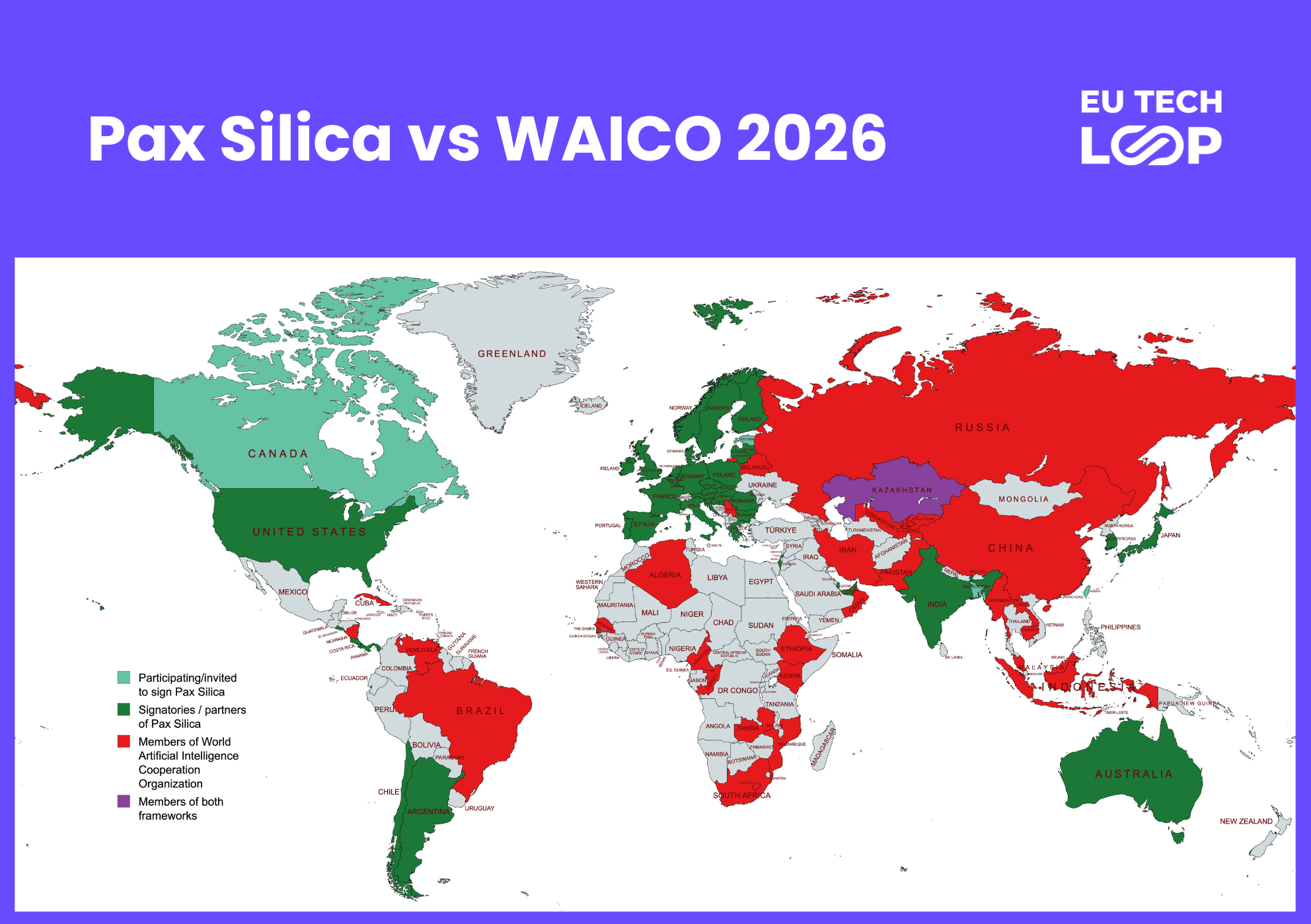
Kazakhstan, a geopolitically vulnerable country squeezed between China and Russia, which has shown strong interest in establishing West-oriented partnerships and decoupling from Russia, is the only country participating in both Pax Silica and WAICO. The country was criticized for this approach, however, a hard-line approach and commentary towards countries that are still choosing between the West and the East might be unconstructive.
Plenty more countries with a high potential - such as Turkey, Saudi Arabia, Egypt, Mexico, and more have not yet committed to any partnerships. For the Global West, it will be important to ramp up its open-source strategies, AI application projects, and regulatory cooperation efforts.
Lastly, one can only hope that the EU’s Executive Vice President Henna Virkunnen’s statement last year that the EU will be seeking to change its’ development support rules, so that the recipient countries don’t end up buying high-risk technologies (e.g., Chinese tech) using the European taxpayer’s money will come to fruition.


