
The bill comes first: costs of doing business in Germany
While the EU claims to be enhancing the Single Market, doing business in Germany - the most populous country in the EU - remains heavily burdened by countless small requirements that raise costs for German and EU founders, deterring many small businesses from entering.

Irish-American Stripe founder Patrick Collison recently stirred up a much-needed debate about the costs of incorporating in Germany. He pointed out the need for contracts to be physically read by notaries in Germany, who then pocket 1% of the transaction value for this service. Knowing countless founders that had to go through this costly ordeal and seeing the cars of my notary-turned college friends, I can only echo that this anachronism is alive and well in Germany.
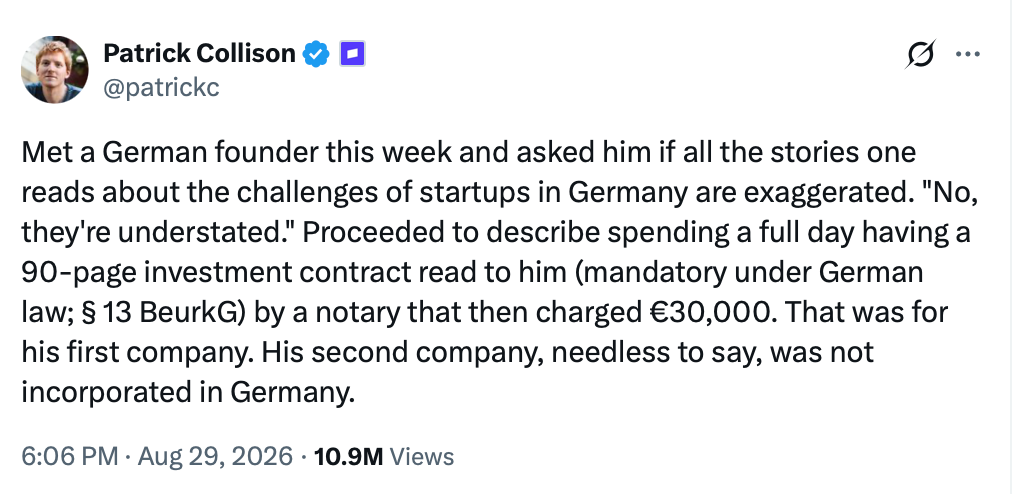
While more than 10 million people read about notary-gate, there are many small requirements for founders of German and EU businesses trying to offer services and products in the EU’s most populous country. Most of them make market access more expensive and probably deter small businesses from even trying.
250 questions to get a VAT number
When an EU business wants to sell goods in Germany and have them fulfilled by an e-commerce warehouse provider such as Amazon, the business needs to apply for a German VAT number. In order to file for a German VAT number, the business needs to submit the German ELSTER “Fragebogen zur steuerlichen Erfassung – Körperschaft nach ausländischem Recht.” This questionnaire includes over 250 input questions and does not open a separate form or decision tree if you are a business from another EU country.
Thanks to LLMs, one might be able to browse and enter all the necessary parts (and omit those that are not needed) within 90-120 minutes. But what comes next are the email follow-ups of the German tax authorities (the Finanzamt Schwerin, to be precise). Suddenly, founders have to submit notarized translations of their residence confirmation in their home country, obtain translations of their statutes of incorporation, and submit a bank letter (which many banks and countries don't even offer). Without counting LLM tokens burned on this process, you can still be sure to spend 500 Euros on attested documents and translations in order to fulfill the German tax office’s requirements. All of this is needed just to sell goods and services in Germany that would result in consumer welfare AND tax revenues.
Recycling fees
Once you hold that hard-fought-for German VAT number, any business planning to sell to German customers needs to file for a LUCID registration number with the Zentralen Stelle Verpackungsregister (ZSVR - Federal Packaging Registry) and pay a minimum of 40 Euros for recycling fees.
Since this summer, non-German businesses have also needed to designate an authorized representative for Extended Producer Responsibility for local packaging compliance, which easily costs another 300-500 Euros per year.
So after one month of paperwork, several thousand Euros in legal, translation, and compliance fees, you are finally set up to sell a few dozen, or maybe a few hundred, products via Amazon Germany. For small businesses (let’s say someone selling 1,000 products in Germany a year), this either means slapping 2-3 Euros on each product they sell in Germany, or just shunning this large consumer market altogether.
"Regime shopping" or the lack of competition in the business climate among EU member states
The European Union's proposal for the 28th regime/EU.inc - an attempt to create a Single Market for innovative startups and companies across the EU - is said to be agreed upon at the end of 2026 at best, with enforcement starting at least 12 months later. Some EU member states have previously expressed concerns and proposed safeguards to prevent the proposal from becoming a tool for "regime shopping," meaning that innovative startup founders would choose specific EU member states in which to incorporate, depending on their business climate.
Instead of worrying about "regime shopping", EU policymakers should aim for healthy, necessary competition among the 27 member states: businesses should be able to passport/elect whichever country offers the easiest and cheapest regime and apply it across the Union. This would lead to lower market access barriers and better prices for consumers, and motivate local policymakers to improve their own laws and rules.
Sometimes it is hard to understand the value of the EU's Single Market when small businesses and founders have to navigate so many hoops and hurdles just to sell their products from one EU country to consumers in another.


