Why European businesses are not using AI tools
Eurostat's 2025 data show that a lack of technical expertise, data privacy concerns, and legal uncertainty remain the main barriers to the use of AI tools among European businesses, even as most companies recognize AI’s potential value.

The European Union is seeking ways to promote the use and application of AI across European businesses, thereby boosting European competitiveness and productivity, while policymakers are trying to simplify the artificial intelligence and data protection rulebook to ease the administrative burden and remove overlapping rules.
In this context, the data from Eurostat’s recent survey on the very basic question - why European businesses are not using AI tools - is highly useful for further political discussion, particularly in the context of the AI Omnibus, Digital Omnibus, and negotiations on the upcoming EU’s budget for 2028-2032.
Lack of technical expertise and compliance-related concerns
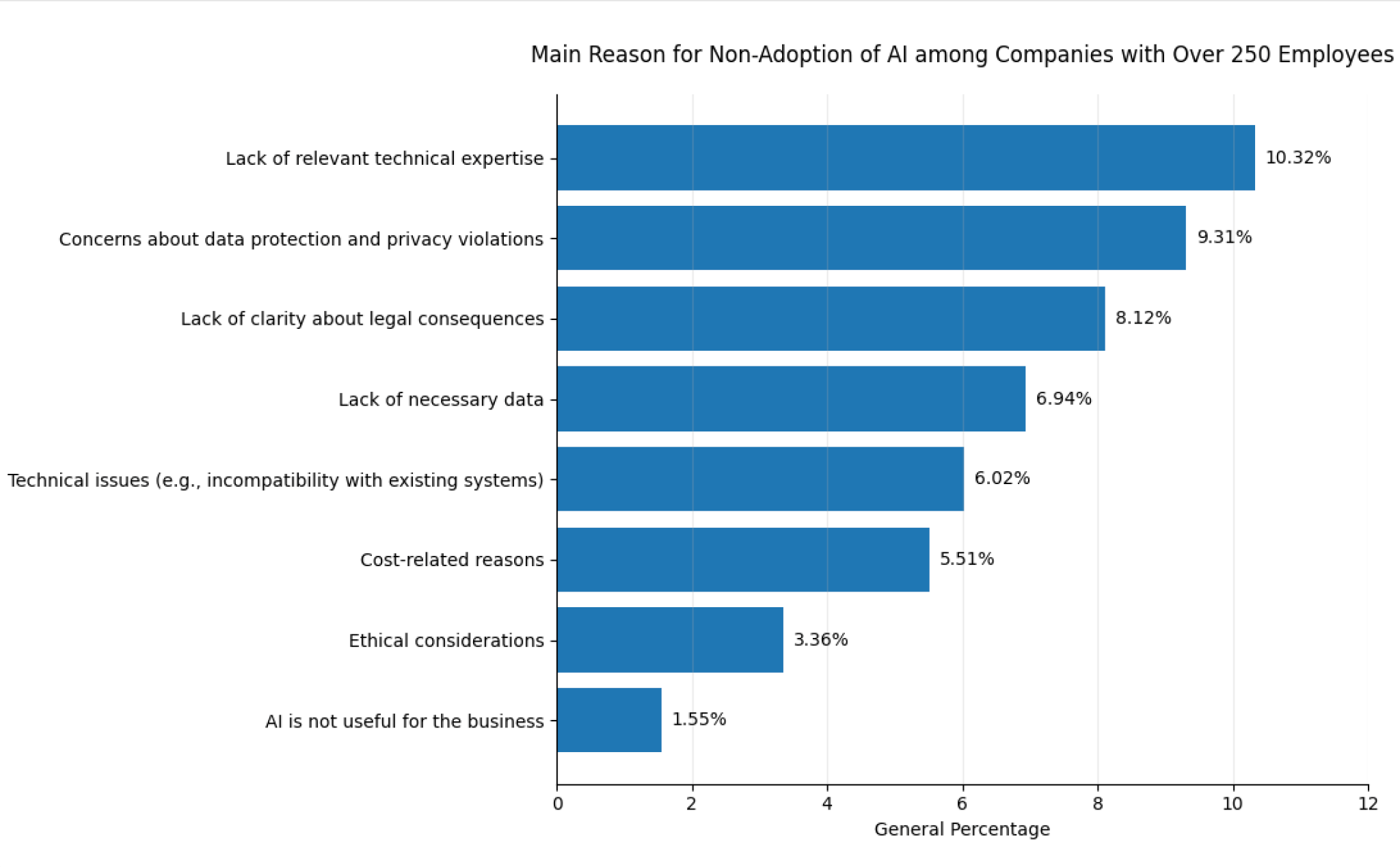
The most telling results among both medium and large companies relate to the lack of technical expertise. This reason is listed as a barrier preventing the use of AI tools by 10,51% of companies employing 50-249 people and 10,32% of larger companies employing more than 250 people.
In addition, European companies are also concerned about data privacy and protection, as well as unclear legal consequences: 7.95% medium-sized companies and 9,31% larger companies cite concerns about violations of data protection and privacy, while 7.51% of medium-sized and 8,12% of larger companies point to a lack of clarity regarding legal consequences.
Overall, the results are very mixed, suggesting that European companies understand that AI tools might be useful to them (only 2,09% of medium-sized and 1,55% of larger companies consider them not useful for their enterprise), but are unable to clearly articulate how the EU can help them.
A similar survey focusing solely on data and AI-intensive businesses would be extremely useful for drafting a framework for future legislative action and for shaping the priorities of the upcoming Multiannual Financial Framework.
Reasons for not using AI tools among companies with 50-249 employees
Only 5,67% of businesses employing 50-249 employees list cost-related reasons, with Portuguese businesses leading the table at 9,56%.
The most common sentiment among all is the lack of technical expertise - 10,51% list it as the main reason. 15,44 % of Danish, 14,63% of German, and 13,99% of Finnish businesses share this sentiment, topping the table. Both Denmark and Finland are normally leading the overall AI adoption charts, so this admission seems to be very self-reflective and critical.
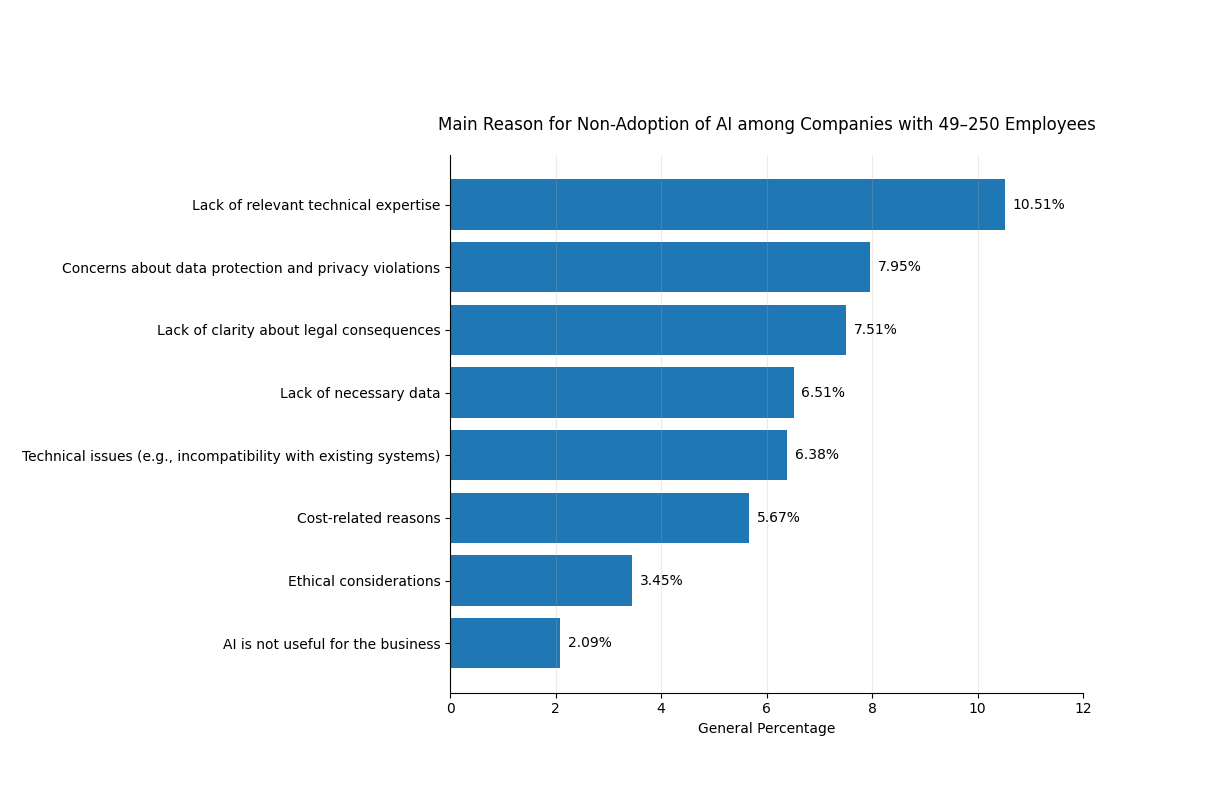
6,38% believe technical issues - such as incompatibility with existing equipment, software, or systems - are the issue, with 11,82% of Finnish, 9,44% Maltese, and 9,42% German businesses agreeing.
6,51% of European businesses believe the lack of necessary data is preventing them from adopting AI tools, with Finns at 10,31% and Germans at 9,12% being the most critical.
Data privacy violations and uncertainty about legal consequences are the second-most-cited barrier, after the lack of technical expertise. 7,95% of European businesses believe that concerns about data protection and privacy violations are preventing them from using AI tools. Meanwhile, 7,51% point to a lack of clarity about the legal consequences.
Only 3,45% of businesses listed ethical considerations as a reason for not using AI tools.
Finally, it seems that the majority understand that AI tools might actually be useful for their businesses, with only 2,09% stating that AI tools are not useful for their business.
Reasons for not using AI tools among companies with over 250 employees
The sentiment about why companies are not using AI tools is similar across larger businesses with over 250 employees.
Only 5,51% of businesses list the costs as the main reason, whereas 10,32% cite the lack of relevant expertise, 6,02% point to incompatibility with existing software and systems, and 6,94% mention the lack of data availability and quality.
Larger companies are slightly more concerned than SMEs about data privacy and unclear legal consequences - 9,31% list concerns about data privacy and protection violations, while 8,12% cite the lack of understanding about legal consequences.
Only 3,36% are concerned about ethical considerations, and only 1,55% believe AI tools are not useful for their businesses.