
EU tech sovereignty: internal divides
The EU’s tech sovereignty plans are moving forward, but foundational debates persist.

The European Union’s tech sovereignty plans are moving forward, with the European Commission expected to present its Tech Sovereignty Package very soon.
Further negotiations on the package within the EU are likely to reflect long-standing internal debates regarding its scope, financing targets (tech sovereignty criteria), and strategic priorities.
Moreover, they will test the EU's readiness to absorb potential retaliation, now that Brussels is poised to frame the package not only through a national security or competition lens, but also through the lens of economic self-interest.
Large vs. small country divide
Larger EU Member States have vocally supported the EU’s vision of tech sovereignty, even gradually removing non-EU services from internal government use. Publicly, the driving narrative is largely security-oriented, aimed to ensure that Europe is safe from external interference, "kill switches," and related threats.
Less publicized but equally critical is economic self-interest: larger countries with growing domestic tech sectors want to keep taxpayer money within their own borders through public procurement, while also seeking to extend this approach to other EU Member States.
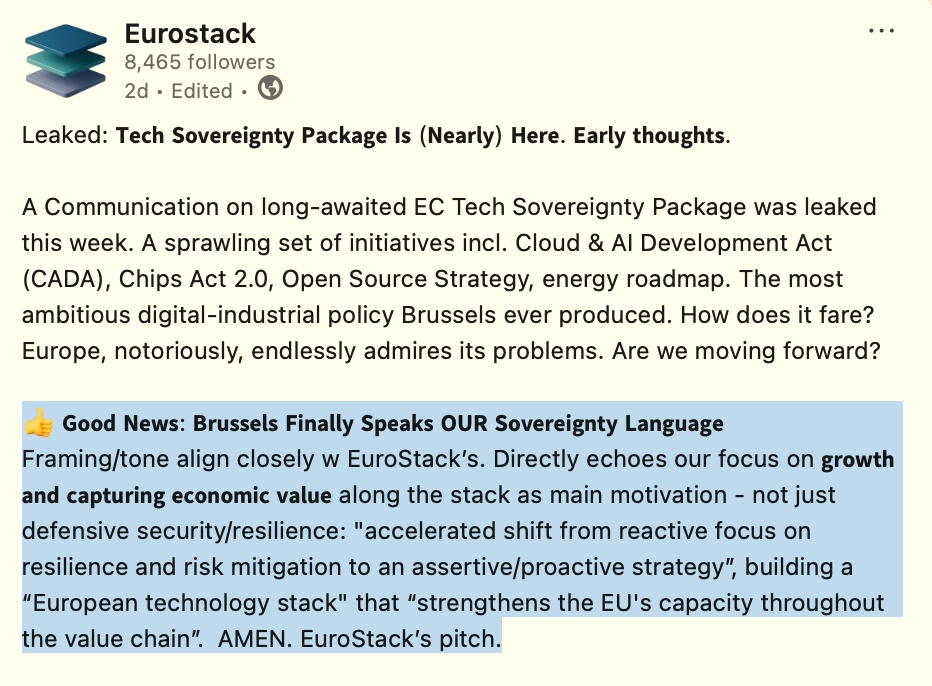
The upcoming EC's Sovereignty Package reportedly shifts away from national security and resilience arguments toward more direct economic reasoning.
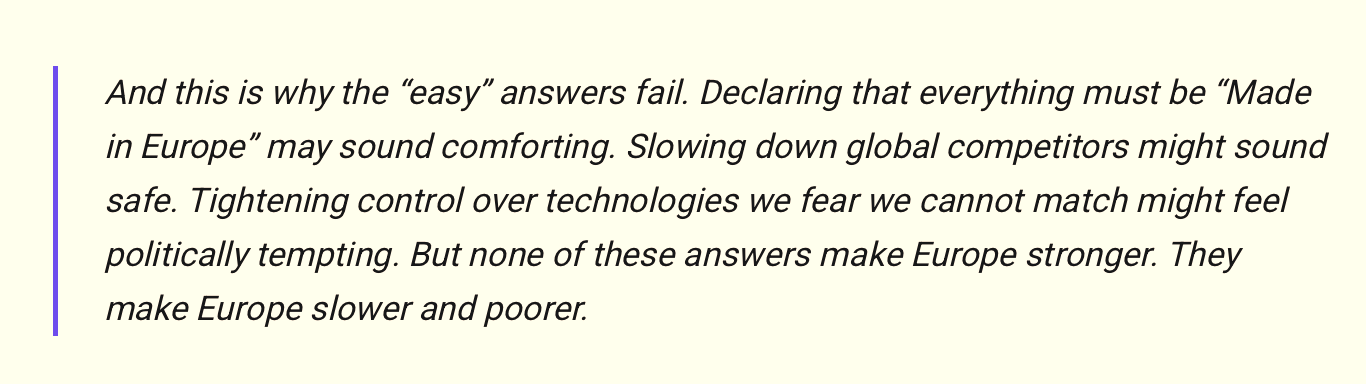
Smaller states, however, have been more cautious. These countries are taking the security aspects of technological sovereignty seriously, but are also considering the big picture: the cost of transitioning to European alternatives, the preparation needed for such a transition, the lack of viable alternatives in some areas, and the potential risks of an overly protectionist approach. As an example, the Danish Minister for Digital Affairs has previously stated at the EU Tech Loop: “Europe will not be sovereign behind walls” (See Picture below).
There is also a clear sense of unequal treatment when it comes to alternatives from smaller states. For example, shifting from Chinese to Swedish Ericsson or Finnish Nokia under the Cybersecurity Act (CSA) is sometimes dismissed by countries like Germany and Spain, and some mobile operators, as too expensive, while that same cost-sensitivity is absent when discussing cloud service solutions.
Sharing the pie: scaling up vs. capacity building
Some internal division across EU Member States revolves not only around the very idea of technological sovereignty and to what extent it should be addressed, but also around the more practical, implementation part - specifically, where EU taxpayers' money would be better spent. This debate applies to virtually all EU tech sovereignty instruments currently under discussion - from the Chips Act 2.0 to the Cloud and AI Development Act.
One side favors focusing on established European tech companies to maximize immediate impact, while the other advocates for investing in capacity-building for growing industries and smaller companies, despite their lack of immediate scale.
The scope: DMA, DSA, and the AI Act included?
The EU Commission website lists a number of initiatives that are aimed at supporting the EU’s tech sovereignty ambition.
The proactive initiatives aimed at enhancing the EU’s tech capacity - either through infrastructural solutions or legislative changes to make the operations and growth of EU businesses easier are clear, well-known, and infrequently questioned. These include the AI Continent Action Plan, AI Factories, the Digital Decade, the Data Union Strategy, the Data Act, and the Startup and Scaleup Strategy, among others.
Interestingly, the webpage also lists the AI Act, the Digital Markets Act (DMA), and the Digital Services Act (DSA) as measures that support the EU's tech sovereignty goals. While this is likely a reference to "open and fair digital markets" and to the protection of citizens' rights in the online space, optically, this contrasts with the EU's long-standing insistence that these regulations are entirely non-discriminatory. For years, the US has criticized these regulations as being designed and implemented with US tech companies in mind, while the EU Commission has consistently pushed back, arguing that these rules are neutral, non-discriminatory, and target very large online platforms (VLOPs), not American companies per se.
The American and the Chinese sovereignty models
The pursuit of technological sovereignty is neither new nor unique to the EU - most developed countries actively promote local tech solutions and capacity building. Historically, these efforts have relied on competition policy and national security measures, which are operationally safer because they make it much more difficult for targeted sectors and countries to retaliate or legally challenge these initiatives.
The United States, as the current leader in digital innovation, faces little competition in its domestic market, so Americans don't need to resort to straightforward sovereignty measures. Some elements of tech sovereignty are, however, present, either through a national security lens or through a push for localization: e.g., the US has removed Chinese infrastructure from its telco networks.
China has previously deployed indirect competition policy and national security-oriented measures to pursue its own technological sovereignty goals. For instance, China recently blocked META from acquiring a $2 billion Chinese AI startup, Manus. Similarly, national security investigations conducted by the Cyberspace Administration of China (CAC) into foreign telecom equipment are speculated to have been one of the reasons why Swedish Ericsson’s and Finnish Nokia's market share in China shrank from 12% in 2020 to only 4% in 2025. Meanwhile, according to a Financial Times report, Chinese companies Huawei and ZTE have retained 30 to 35% of the European market, while in Germany, 59% of all 5G equipment remains Chinese.


