EU Member States' influence in Brussels: fit for neither the present nor the future
As the EU speeds up lawmaking, many Member States - especially smaller ones - are struggling to keep pace due to a lack of manpower and outdated practices. To avoid becoming mere observers, countries must urgently rethink how they work in Brussels - and at home.
The conversation about the need for the EU to speed up its decision-making process, limit the use of vetoes, and otherwise strengthen its institutional framework is not new. However, there is rarely any debate over whether individual EU Member States are keeping pace with the EU’s accelerating legislative speed, or if they are able to effectively reflect their national stances.
While the EU Commission is reportedly considering deploying Commission officials to Member State capitals to boost its local influence and policy awareness, Member States are failing to do the same when it comes to their own representation in Brussels.
Inter-institutional struggles
Size is, of course, not everything. Some smaller EU Member States are effective regardless of leaner bureaucracies, however, most face a wide variety of issues due to their outdated approach to EU affairs.
The issue spans a lack of manpower, difficulty in hiring and retaining talent, poor coordination between the PermReps and Member States’ capitals, a lack of a horizontal approach to EU policy management at the ministerial level, and a failure to adopt new technological solutions when budgetary or political constraints make increasing headcount impossible.
Ultimately, this leaves some Member States acting as mere observers and reactors rather than active participants in the EU’s legislative process. For these countries, being proactive in shaping the EU's legislative agenda is entirely out of the question.
Now that the conversation on the Single Market and EU moving towards a pragmatic federation is becoming more relevant, Member States - especially smaller ones - should follow the best practices of more effective Member States and even the EU institutions, and enhance their representation in EU policy matters.
What’s at stake
National government representatives serve on roughly 140 committees and working parties in Brussels, covering a wide variety of policy matters that affect their economies, industries, and citizens. And with the EU’s increasing legislative speed, methods that worked in the past may no longer be fit for the present or the future.
The exact size and responsibilities of countries' representatives in Brussels - Permanent Representation offices - are notoriously difficult to track, but as reported by the Danish Think Tank Europa in 2019, Member States had 200 to only 69 representatives.
According to the report from 2019, Western European countries like Germany, France, Belgium, Austria were leading with 150 to 200 employees, the middle group - Romania (chairing the Council of the EU at that time), the UK, Italy, Spain, the Netherlands, Sweden, Poland, Czechia, Finland, and Ireland had 103 to 147 employees. The third group - mostly smaller and/or Eastern European EU Member States, such as Lithuania, Portugal, Hungary, Slovakia, Luxembourg, Croatia, Denmark, Estonia, Cyprus, Slovenia, and Latvia had only 89 to 69 employees - two to three times less than their Western counterparts.
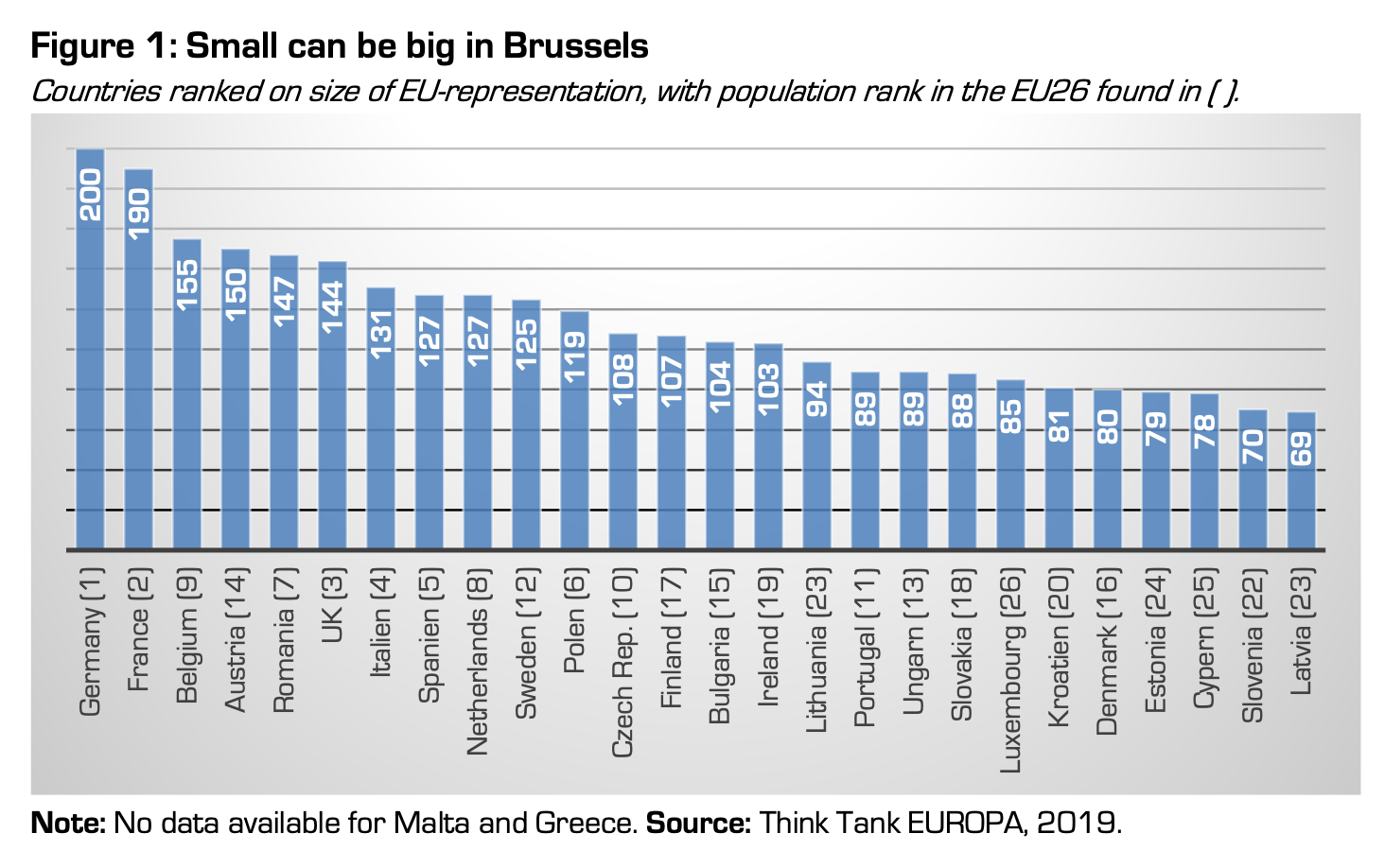
While size does not equal quality, underrepresented countries often struggle to meaningfully impact EU affairs. This manpower deficit is most visible during their Council of the EU Presidencies, when hiring external talent is difficult and core is overstretched.
Unequal stakeholder ecosystems across the EU
Policymakers’ agendas in democratic countries are naturally also driven and influenced by their voters, who are represented by industry representatives, individual experts, thought leaders, and the non-governmental sector.
However, when it comes to EU affairs in Member States with limited ecosystems, the connection between EU policy and various stakeholders is weak. As a result, policymakers rarely receive timely, constructive feedback when they need it most, forcing them to make decisions based solely on inter-institutional dialogue or limited interactions with a few proactive stakeholders.
While the European private sector's lack of a philanthropic approach to NGOs, and the lack of an ecosystem-led approach to industry associations across the EU, warrants its own article, smaller Member States suffer the most. There, the industries are smaller, domestic trade groups must often operate as big tent organizations to survive, which limits their specialisation. On top of it, smaller media sector lacks the capacity to proactively and contextually cover the EU affairs.
The quality of public debate on EU policy in smaller Member States is poor - delayed at best, non-existent at worst. Very frequently, the public discussion on EU legislation only begins during the transposition phase, a stage where changes are limited. Consequently, the debate remains superficial, trapped between glossy official EU press releases and a defeatist, overly critical and pessimist approach.
The EU & Irish consultation mechanisms to follow
While the EU’s stakeholder consultation mechanisms, such as the "Have Your Say'" platform, receive their fair share of criticism, they are nevertheless inclusive and transparent models that should be replicated at the Member State level.
Countries like Ireland have already replicated this approach through open and transparent public consultation systems. In Ireland, various stakeholders are invited to share their views not only on the country’s EU Presidency priorities, but also on specific legislative files currently at the center of EU debate, such as Ireland's recent call for feedback on the EU’s Digital Networks Act.
While some may fear that the local public sector would be unable to manage diverging opinions - potentially leading to further chaos - the traditional methods for public consultation used by most countries (such as roundtables and ad hoc meetings) are clearly no longer effective. Creating new frameworks that allow all interested parties, regardless of how polarized their perspectives may be, to publicly voice their views on EU matters would enhance transparency, increase policymaker accountability, build trust in both local and EU institutions, and drive overall engagement and interest in EU affairs.
What’s possible aside from more manpower
The argument that the bureaucracy is already too large is hard to counter, especially in countries with a more austere approach to government spending and public debt. However, EU affairs is not an area where governments should cut costs, especially now that the EU is moving toward a more integrated Single Market with harmonized rules and fewer Directives, which previously allowed some flexibility for local needs and perspectives. The available data on staff numbers within EU institutions alone (Pictured below) should be a convincing enough argument for Ministries of Finance and naysayers to understand that EU lawmaking is vast, complex, and requires sufficient investment to constructively participate in.
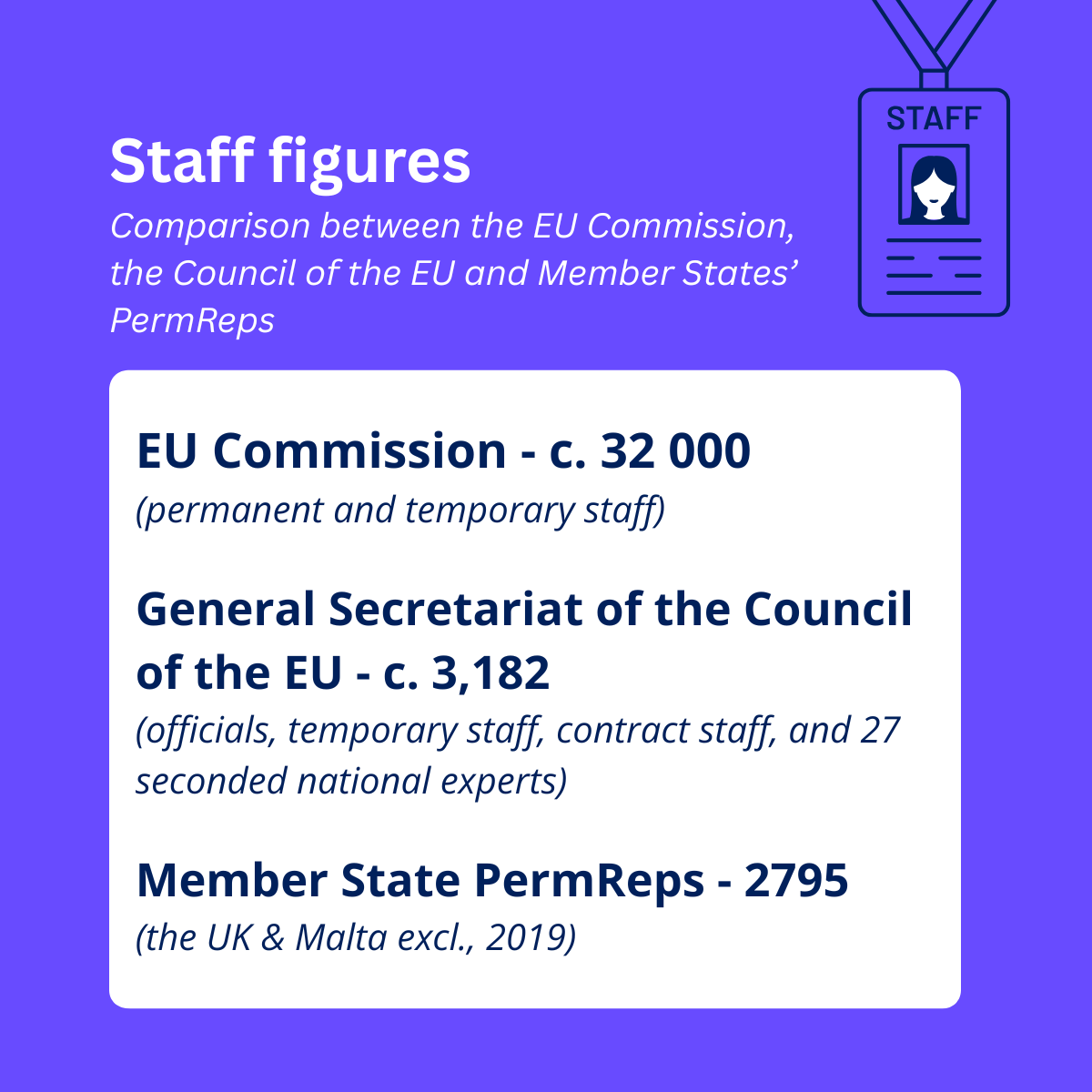
However, simply allocating more money for staff or creating stakeholder consultation platforms are by no means silver bullets. Other challenges, such as poor horizontal coordination between ministries, inability to retain institutional memory, finally - time constraints, can also be addressed from a technological perspective, ranging from custom-made AI solutions (a great opportunity for European tech), to other means.
More importantly, by beginning to work on these tools, collecting relevant data, outlining administrative structures will naturally push countries to rethink their current modus operandi on EU affairs.
Finally - the EU Commission's recent Communication on better regulation sets out plans to introduce new IT tools to improve lawmaking. The Commission reportedly wants to become AI-ready, while the Estonian government is prioritizing the application of AI (public sector included) at the highest political level. It looks like both EU institutions and Some Member States have understood that if AI improves labor productivity and saves time in the private sector, it should be just as helpful in the public sector - whether at home or in Brussels.
 EU Tech Loop