
Who uses AI in Europe - and where it’s still taboo
The EU is funding AI adoption, drafting preparedness plans, and issuing ethics guidance, but AI tool use remains uneven and sometimes taboo. With 64% of Europeans saying AI literacy will be essential by 2030, the real test is turning ambition into measurable, high-scale outcomes.


The European Union keeps simultaneously investing in new measures to support AI adoption among both individuals and enterprises, drafting new preparedness strategies, and issuing various new guidelines on the ethical use of AI.
According to Eurobarometer’s survey on The future needs for digital education, 64% of Europeans strongly agree and somewhat agree that by 2030, everyone will need to be AI-literate.
Since 2021, the use of AI technologies has organically grown by 12.30% among European enterprises, almost a third - 32.7% - of Europeans admit to having used AI tools.
Stark differences in AI use across EU countries hint that, while in some places using generative AI for formal education and professional purposes isn’t looked down upon and is actually encouraged, in others it might still be taboo - reflected in extremely low (and highly unlikely) self-declared use of AI tools.
Most popular AI tools in Europe
In 2025, Open AI declared it had 120,4 million active users in the European Union - roughly 26% of the EU’s population which, more or less, echoes the European statistics on generative AI use in 2025.
Other AI chatbots and tools are more hesitant to disclose their user base in the EU, however, given that Open AI’s Chat GPT has over 80.02% of the European market share, the rest of 19,8% is likely to be divided between Perplexity, Microsoft Copilot, Google Gemini, and Claude.
The use of generative AI for formal education is low
Less than a tenth - 9,8% of Europeans on average - admit to using generative AI for formal education purposes in 2025.
At the bottom of the list are Hungarians, with an extremely (and highly unlikely) 0,62%, followed by Romanians (3,37%), Poles (4,59%), Bulgarians (5,17%), and Germans (6,04%). The leaders in using AI in education are Sweden with 20,99%, Malta with 20,22%, Denmark with 17,86%, Spain with 16,26%, and Estonia with 15,41%.
According to Eurobarometer’s recent survey on Future needs for digital education, 54% of Europeans have a balanced view and believe that AI can bring both benefits and risks in the classroom, with less than a quarter, 22% believing that AI does not belong in the classroom at all.
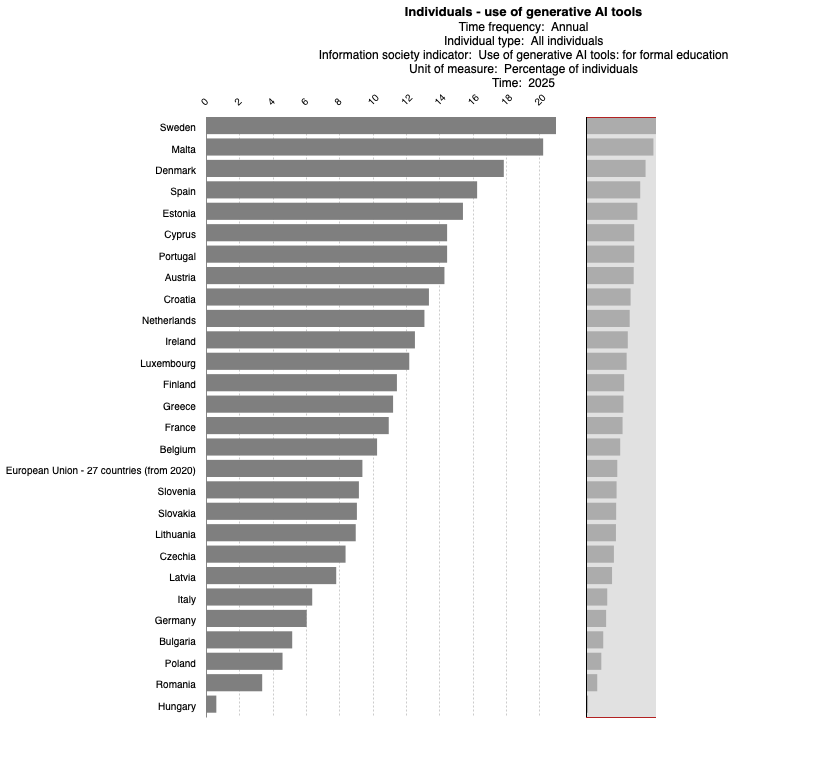
While the EU has already published the ethical guidelines for the use of AI in education, and some educators are openly opposed (or simply fatigued by) students’ growing use of AI, two areas need urgent attention.
First, the EU needs to improve access to safe, age-appropriate AI tools for pupils, students, and educators - so everyone can build skills under supervision. This is especially relevant in countries with lower overall levels of digital skills and Internet access.
Secondly, educators, along with Member States Ministries of Education, need to deep-dive into how AI can help in their day-to-day work, especially when teaching learners with learning difficulties and disabilities (dyslexia, dyscalculia, ADHD, autism, and others). Done well, this is a major opportunity to test new, personalised approaches and adapt teaching techniques to achieve the best results for educators and learners.
15.07% of Europeans admit to using generative AI for work purposes
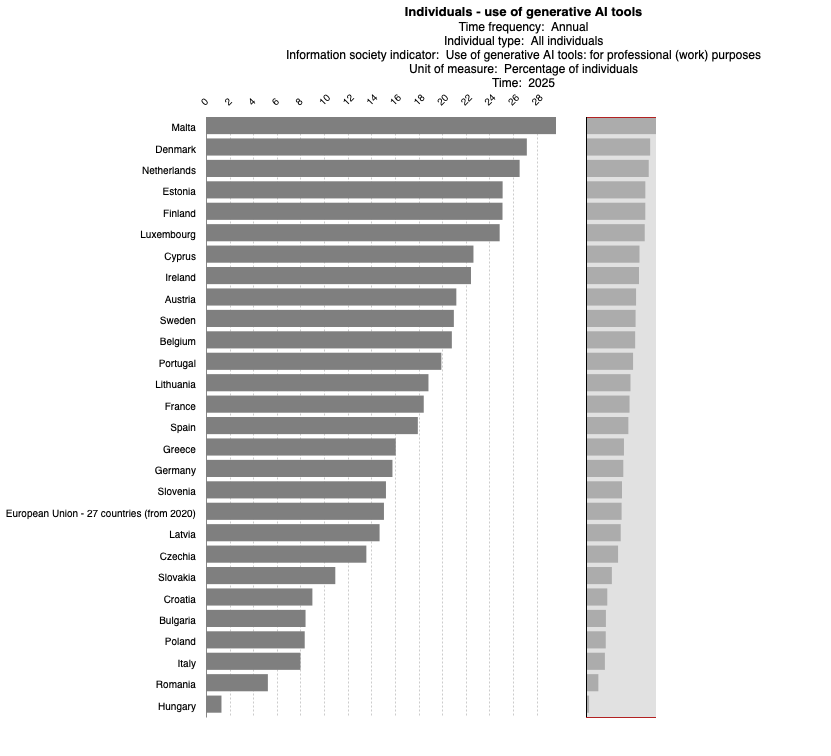
Slightly more - 15.07% of European individuals, on average, admit to using generative AI for work purposes.
Again, at the bottom of the list are Hungary (1.31%), Romania (5.24%), Italy (8.00%), Poland (8.36%), and Bulgaria (8.43%). Malta leads with 29.64%, followed by Denmark (27.17%), the Netherlands (26.56%), Estonia (25.12%), and Finland (25.11%).
A quarter of Europeans admit to using generative AI for private purposes
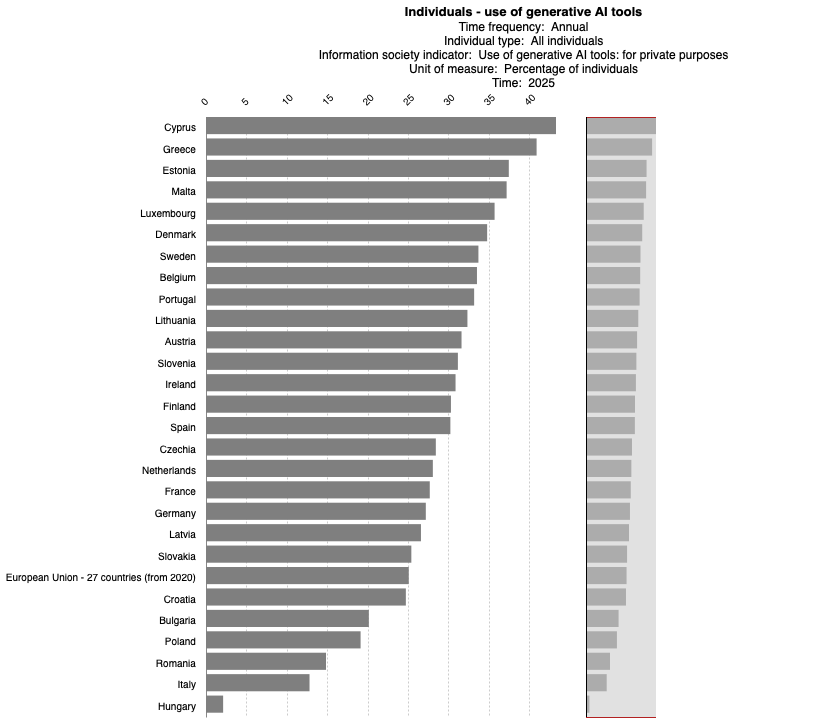
Europeans (but not all) are more relaxed about disclosing the use of generative AI for private purposes.
Cyprus leads the way with 43.13%, followed by Greece (40.91%), Estonia (37.47%), Malta (37.20%), and Luxembourg (35.71%). Hungary is, yet again, at the bottom with only 2.12%, followed by Italy (12.81%), Romania (14.85%), Poland (19.13%), and Bulgaria (20.15%).
Denmark leads in AI adoption among businesses
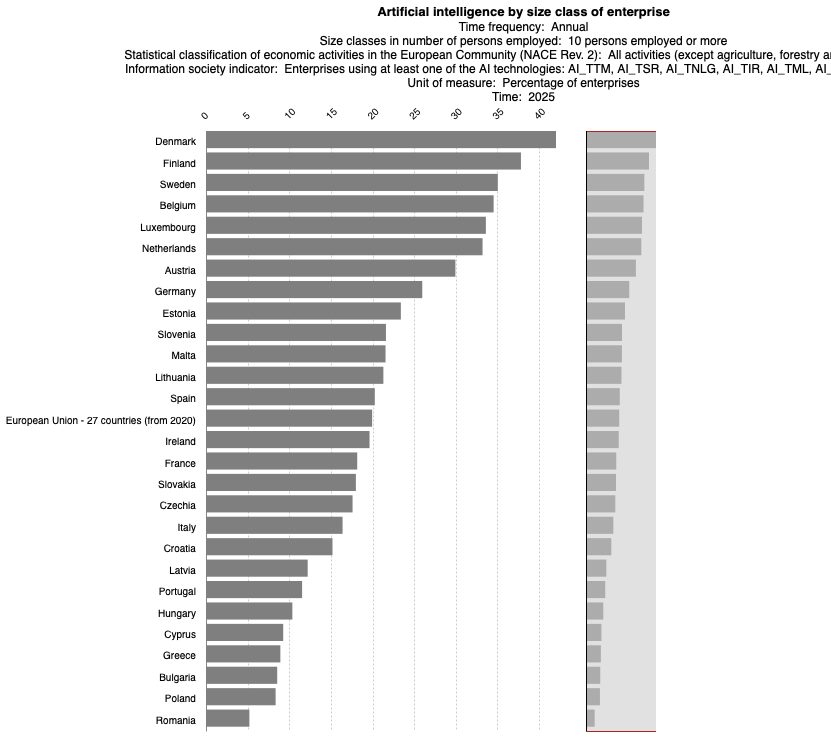
The use of at least one type of AI technology among European businesses stands at around 19.95% on average, a 12.3% increase since 2021.
The numbers vary significantly across countries: while Nordic and Benelux countries lead the way, Southern and Eastern European countries remain at the bottom. The European businesses also differ considerably in their AI maturity: while some are well underway with AI transformation (or at least have strong business processes and data management foundations), others are still taking a basic, tool-by-tool approach.
Denmark leads the use of AI tools among businesses with 42.03% (+18.14% since 2021), followed by Finland with 37.82% (+22.03% since 2021), Sweden with 35.04% (+25.11% since 2021), Belgium with 34.54% (+24.22% since 2021), and Luxembourg with 33.61% (+20.61% since 2021).
At the bottom of the list are Romania with 5.21% (+3.83% since 2021), Poland with 8.36% (+5.5% since 2021), Bulgaria with 8.55% (+5.26% since 2021), Greece with 8.93% (+6.32% since 2021), and Cyprus with 9.27% (+6.68% since 2021).
While the EU's AI Continent Action plan and Apply AI strategy are moves in the (generally) right direction, the EU should now shift towards deep dives into sectoral uses of AI, business processes, and real readiness to deploy AI between different types and sizes of businesses.
Political strategies often end up as a product of competing ideas and political ambitions - and both strategies certainly reflect that.
Measureable KPIs at Member State level, continued focus on high-scale-only initiatives (whether AI-upskilling or improving access to compute power and data), and clear differentiation by business type, size, and AI maturity can help the EU move ahead swiftly with targeted support, without wasting time and taxpayers' money on high-cost and low-impact initiatives.