
Cold (space) war: why the US and the EU are still in the same boat
Ukraine and SpaceX announced they have found a way to prevent Russian armed forces from using Starlink, while Russian propagandists reacted harshly - not only toward SpaceX, but toward Palantir too. Meanwhile, communications from two European satellites were intercepted by Russian spacecraft.


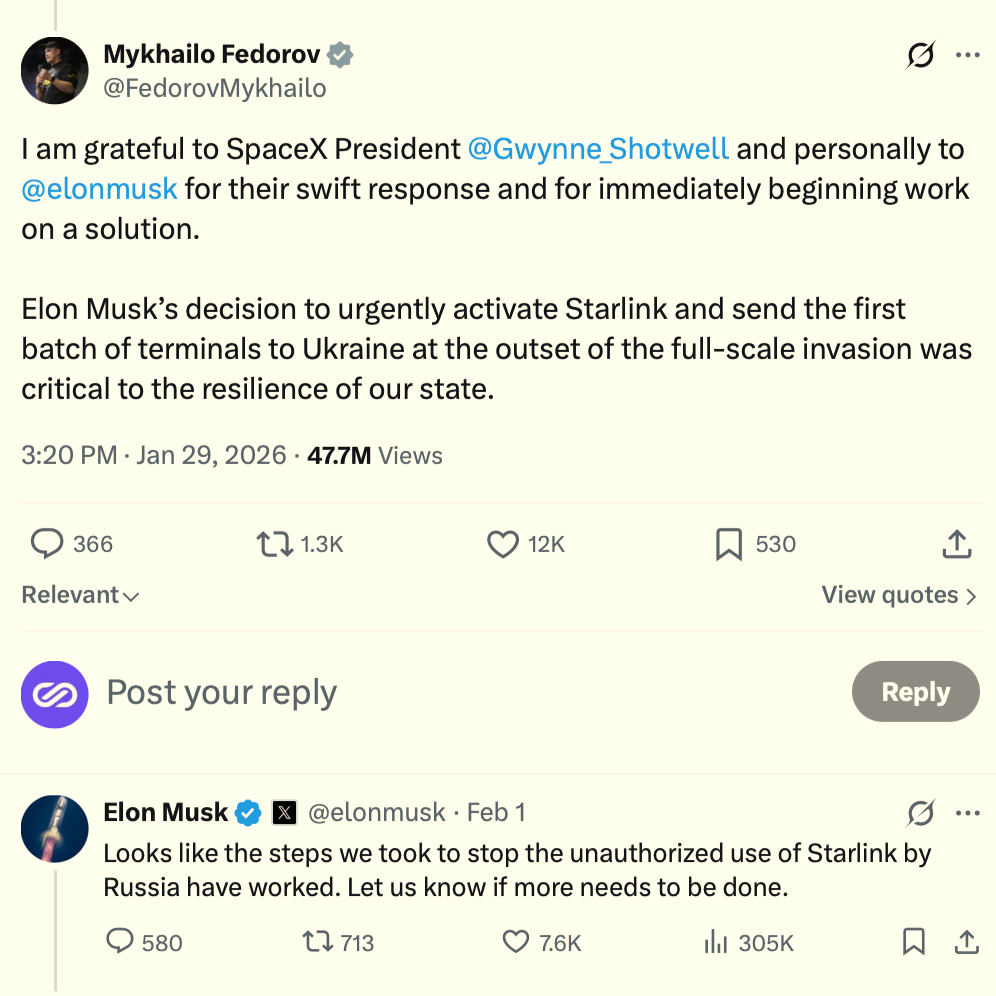
At the beginning of February, Ukraine’s former Digital Minister, now Defense Minister, Mykhailo Fedorov, and Elon Musk exchanged some niceties on X.
Ukraine's minister publicly thanked Elon Musk and SpaceX for cooperating with Ukraine to ensure Starlink kits do not end up in the Russians’ hands, and Elon Musk responded positively.
Russians threatening American tech
It looks like Russians aren’t exactly thrilled with Ukrainian cooperation with American tech companies.
It didn't take long until Russian propagandist Vladimir Solovyov reacted to news about reignited cooperation between SpaceX and Ukraine, with what could only be described as one of the best advertisements for both Palantir Technologies and SpaceX in Europe so far:
“Everything that Elon Musk has worked on - everything we see now - serves the war effort against Russia. All Palantir Technologies does is test the battlefield to kill Russians <...>”
Solovyov goes on to question why “Elon Musk’s satellites” aren’t yet legitimate targets for Russia, arguing that a “nuclear detonation” in space could “seriously solve this problem.” Other participants on his show were quick to point out that any nuclear detonation in space would affect Russia’s satellites and other equipment too, but they were just as quick to say it won’t be as painful for Russia, since it’s lagging behind in the so-called space race.
Russian state television is now threatening @elonmusk. Solovyov the maniac is calling for Russia to carry out a nuclear detonation in space to destroy Starlink.
— Drew Pavlou 🇦🇺🇺🇸🇺🇦🇹🇼 (@DrewPavlou) February 2, 2026
Legit maniacs. pic.twitter.com/965h1Ewz68
The statements are classical intimidation tactics with not much substance: even if Russia is willing to destroy its own equipment in space to take out Musk’s satellites, it's highly doubtful that Russia’s main partner - both on land and in space - China is ready to do the same and would give a greenlight for Russia.
European satellite force majeure?
Nevertheless, Russia and China have already developed technologies that could do far more harm to American and European satellites without compromising their own equipment.
Last week, global media outlets reported that a Russian spacecraft intercepted European satellites’ communication channels, making the data transferred via these satellites vulnerable and, essentially, taking over control of said satellites. Shockingly, as reported by the Financial Times, the European satellites' command data was unencrypted, thus highly vulnerable.
Reports of Russian and Chinese space agencies collaborating on technologies to intercept and take control of foreign satellites have been circulating for years. Moreover, BRICS countries are declaring (at least on paper) their cooperation and a focus on developing joint space capabilities, while their coordination of positions in international bodies like the International Telecommunication Union (ITU) is usually more fruitful than what we see between the EU and the US.
Transatlantic interdependence
Although the EU and the US might certainly seem as being oceans apart politically, having reached a point of no return, space and satellite connectivity show that the continents are still very much interdependent, while the traditional geopolitical adversaries are slowly but surely moving forward.
SpaceX / Starlink relies on EU Member States’ spectrum licences, as well as on regulatory requirements for satellite activity in (and above) Europe. The incoming EU Space Act’s new requirements could be very costly for SpaceX, as could the Digital Networks Act’s provision for EU-wide satellite licensing, if it’s later weaponised against non-European companies. With 9 million users globally, SpaceX certainly sees Europe as a lucrative market, but a very difficult one.
As far as Europeans are concerned, in the event of any major security force majeure, Europe may still need to rely on Starlink. While Europe keeps investing in its own satellite communications capabilities, it would still take many years, and major investment, to reach efficiency and commercial success comparable to Starlink. Ukraine’s example shows that connectivity is needed fast and at scale, for both civil and military purposes.