
Study: data protection rules slow LLM rollout in Europe
A new Gov AI study reveals that EU data protection rules are stalling AI adoption, leaving 11% of advanced LLM releases delayed or blocked in Europe compared to the US. Meta faced the biggest hurdles, withholding 26% of its models from the bloc.

Global tech companies are increasingly citing the European Union’s regulatory framework as the main reason their latest services and tools are delayed or not rolled out in the EU. Depending on the tool, the Digital Markets Act (DMA), the Artificial Intelligence Act (AI Act), and the EU’s data protection rules are the most commonly cited reasons why European consumers get to test and use these services later than their counterparts in the US.
Gov AI released a report on 375 large language models (LLMs) released over the past 8 years (June 2018 - May 2026), comparing delays across the United States, the European Union, and the United Kingdom. The report found that compared to the US, at least 11% of model releases from companies such as Meta, Google, OpenAI, and Anthropic were delayed or not released at all in the EU, while 7% were delayed or not released in the UK.
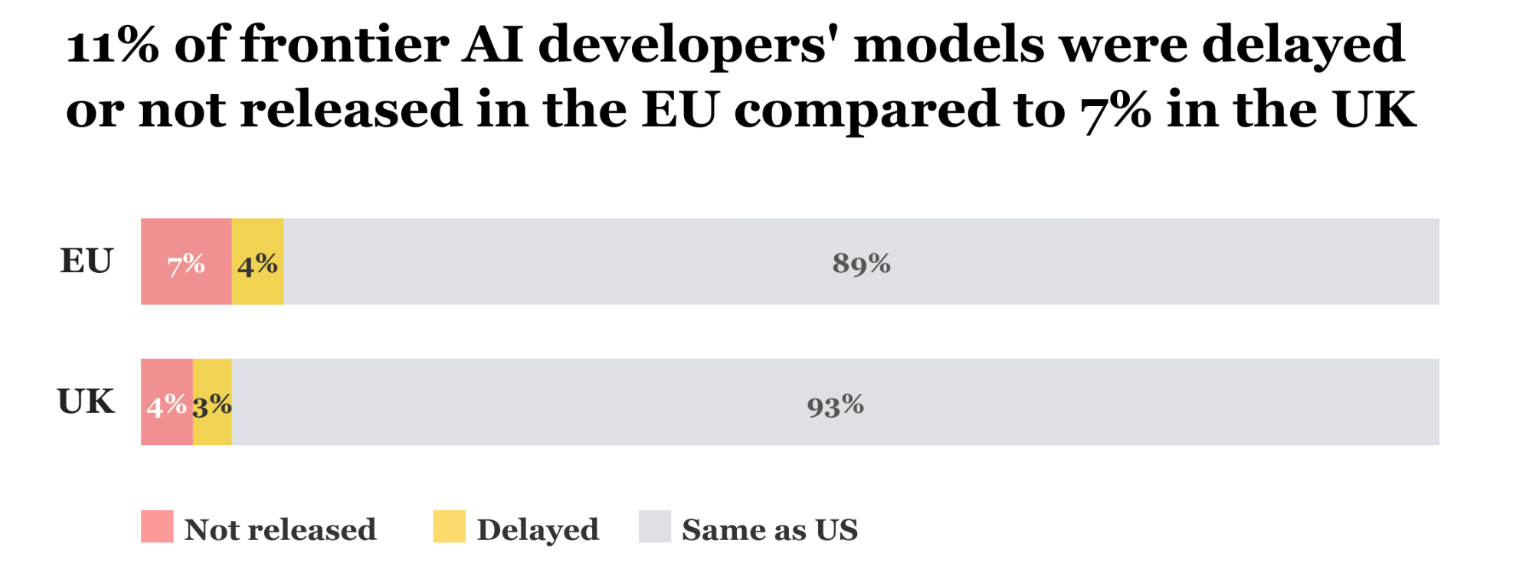
Of the 68 examples of delays and non-releases in the dataset, regulatory factors are the primary cause in 56 cases. As an example, the EU experienced a 71-day delay in the web app release of Claude 3 Opus, while Meta had the highest overall rate of delays and non-releases, with more than a quarter (26%) of its releases delayed or withheld in the EU and 15% in the UK.
Data protection limitations: a rigid framework and a lack of clarity
The report identifies data protection regulations as the primary regulatory barrier, with non-text modalities (such as images, audio, and real-time video) facing greater barriers than text. Given that the Digital Markets Act (DMA) was only enforced starting in 2023, while the AI Act was adopted in 2024, the potential negative impact of the DMA and the AI Act is yet to be seen in the coming years.
Although the UK and EU share similar data protection laws, such as the GDPR, which was adopted before the UK exited the EU, barriers seem to be larger in the EU than in the UK. The authors state that the reasons for this are the EU’s more “aggressive enforcement” and the slow clarification of how data protection rules apply to the training and deployment of LLMs.
The EU does seem to understand that its rigid data protection rules are limiting AI development in Europe, as the Digital Omnibus, which focuses on making data rules more workable for AI development, is currently being considered in the European Parliament.
However, the EU is currently also reviewing the EU Copyright Directive and the AI Act’s copyright provisions to protect authors’ rights. This could make the availability of the most advanced AI models even more difficult in the future if applied too rigidly.
One of the authors, UK AI policy researcher at GovAI John Lidiard, said:
"It’s important that policymakers in the EU and the UK are calibrated to the risk of regulatory barriers causing delays for their citizens and businesses in accessing the latest AI models. Our report finds that European regulation, primarily the GDPR, led frontier AI companies to sometimes delay model releases or in some cases not release models at all to the EU and UK. Policymakers should consider delays to model access as a factor when implementing and designing AI-related regulations."


