
Confusing messaging on potential network fees at the ITRE committee
At ITRE, EVP Henna Virkkunen pitched the Digital Networks Act. The DNA's Articles 191–193 revive fears of de facto network fees, and S&D’s Mattias Ecke pressed for safeguards. The Commission offered little clarity and hinted it could later “revise” the mechanism.

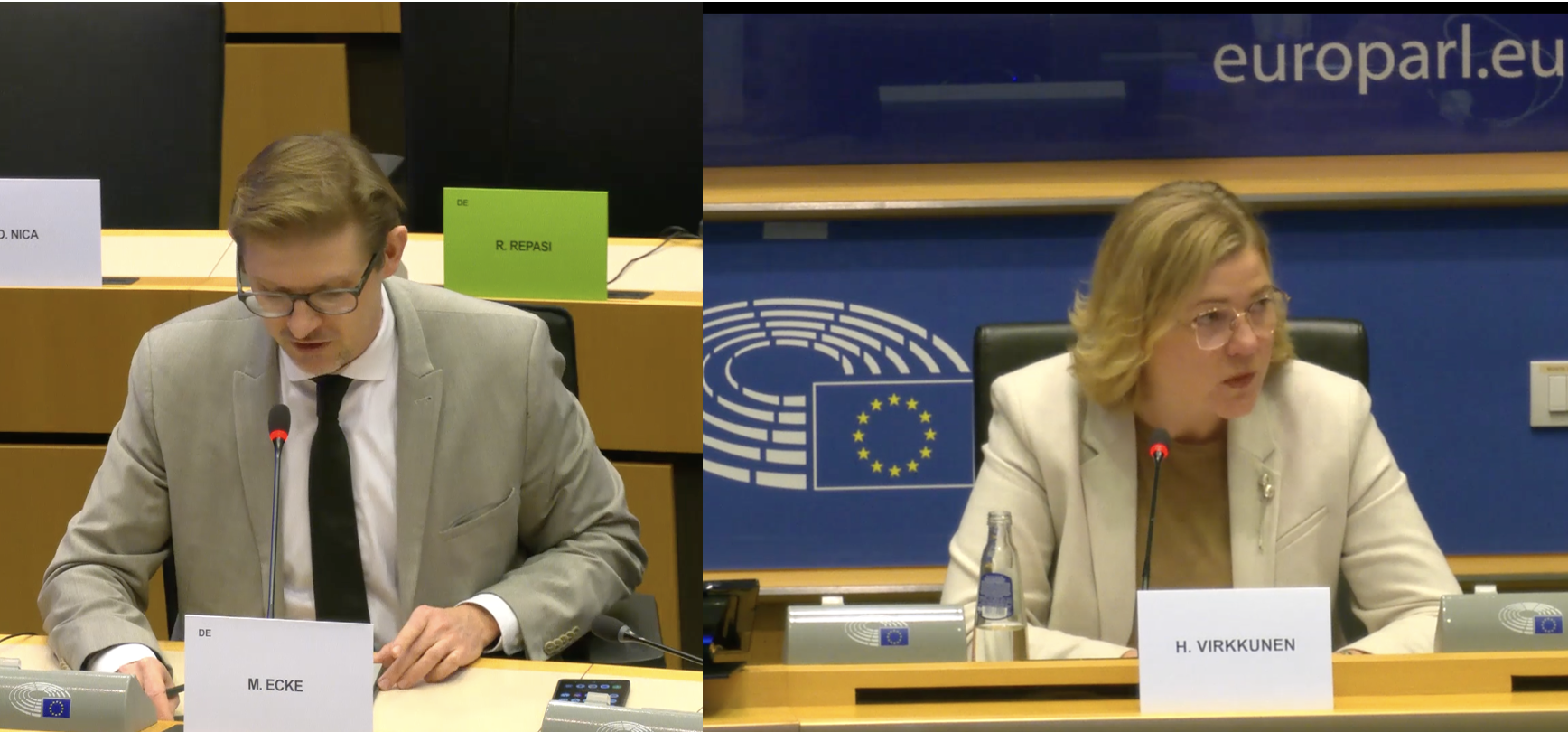
On Thursday, European Commission Executive Vice President for Technological Sovereignty, Security, and Democracy Henna Virkkunen visited the European Parliament’s Committee on Industry, Research and Energy (ITRE), where she presented the revised Cybersecurity Act and the Digital Networks Act (DNA).
Articles 191–193 of the DNA raise serious concerns for consumer and industry associations alike, as they see them as a gateway to introducing de facto network fees on content-provider platforms - a subject that has surfaced before in different forms and was largely rejected as unnecessary and harmful, both at Member State level, within the internet community, and even by consumer organisations.
MEP Ecke: how will the Commission prevent “voluntary cooperation” from turning into de facto network fees?
Mattias Ecke, a German MEP from Progressive Alliance of Socialists and Democrats in the European Parliament, asked Executive Vice President Virkkunen how the Commission plans to prevent the voluntary cooperation mechanism set out in the DNA from evolving into de facto network fees - seen as harmful for consumers and net neutrality:
“How will the Commission prevent that this voluntary cooperation of dispute settlement mechanisms in the area of interconnection [does not evolve] into de facto network access of fees system which could disadvantage consumers and also endanger net-neutrality? Also on net neutrality, some recitals are missing that would in practice, according to some consumer organisations, weaken net neutrality <...>”
The MEP later questioned the interplay of BEREC and national regulatory authorities, which is also a valid concern - the DNA’s text essentially ties national regulatory authorities to BEREC through multiple steps that require BEREC’s opinion (we analysed it here). Only after notifying BEREC and receiving its recommendations can the regulatory authorities proceed to providing “options” to the two parties in dispute.
The current system works well, but we need changes… because some Member States have had difficulties
Henna Virkkunen responded to an MEP's question in a largely diplomatic, obscure, and somewhat contradictory way by first recognising that consultations on the DNA showed the IP interconnection dispute resolution system functions well, and that there was no appetite for a strict, EU-wide regulatory mechanism on it:
“When it comes to these network operators and the services who are using these networks, according to our feedback (we had very broad consultations with the stakeholders, with the operators), the main message was that generally, currently, it’s working well, so because normally these are, of course, corporate agreements what the companies and businesses are doing together, and there was no wish that we are coming the rules that are really [aimed] to regulate these contracts"
Interestingly, Henna Virkkunen repeated the same message a few times: the current system works well - except in some Member States (no specific examples were mentioned), which have faced challenges:
“So, generally, it looks like it’s working well. We know that in some Member States, with some operators, they have had challenges, that is also why we are proposing this mechanism. [So] that the Member States could support them and we are also planning to have European guidelines, also for that. <...> But mainly it looks that it is working well. And of course, businesses have their own contracts and I also think we should avoid going in with our rules, especially when it’s the technology is also developing now very fast”
Henna Virkkunen did not answer MEP Ecke’s question on how the Commission plans to practically prevent the voluntary mechanism from turning into de facto network fees, instead only mentioning that the Commission can “revise this part” - probably signalling that the centralised approach to dispute management in the interconnection area could be strengthened:
“But of course if we see that we are facing major difficulties somewhere, we can of course revise this part and it’s also included here. But mainly these business contracts, it seems that there are no problems generally and that was our feedback here”
Why change what isn’t broken?
One could ask: if the system works well, why change what isn’t broken? Which Member States are facing the biggest difficulties with the existing dispute resolution mechanism? Are they smaller Member States with small, underfunded national regulatory authorities that may genuinely need BEREC’s support - or larger countries that already have the capacity, but wouldn’t mind using a centralised EU mechanism to strengthen their position, often with an interest in supporting their own telco operators?
Henna Virkkunen’s answer reads like many other justifications for new pan-EU rules, citing the need for harmonisation, resource sharing:
“We also see that when we are going more into European harmonized rules, it’s also important that we have more resources <..> centralised resources in BEREC who can help our Member States. But <...> the Member States and their authorities, are of course, are still playing a very important role. So we are combining here the important role of Member States because there are different situations <...> but also facilitating more cooperation on the European level, and more harmonized framework, aiming to have a better Single Market”
 Egle Markeviciute