
CEE AI Index 2026: northern and southern divide
The AI Chamber's CEE AI Index 2026 reveals a region split in two: northern and central CEE countries are ready to lead on AI adoption, while the southern tier is still building foundations and may struggle to navigate the upcoming AI Act.
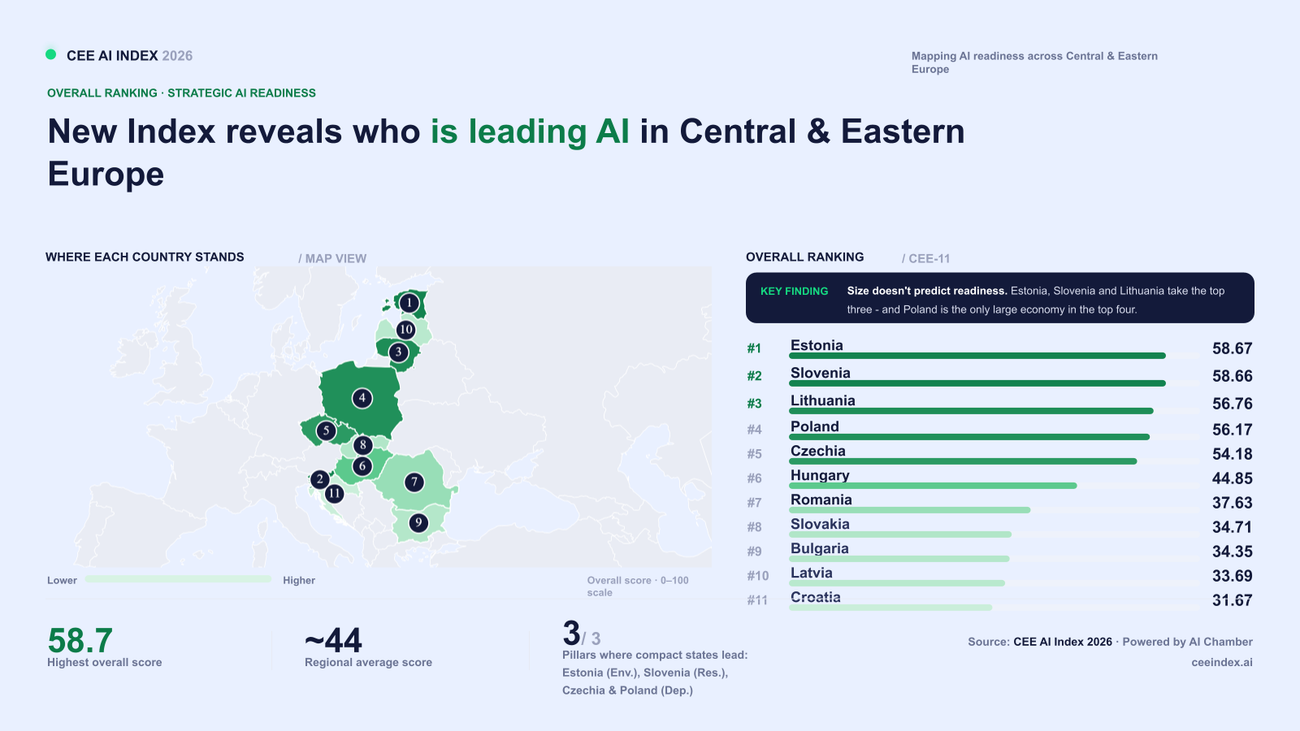
The AI Chamber's CEE AI Index 2026 measured strategic AI-readiness across 11 EU Member States in Central and Eastern Europe through three key pillars: a) environment (governance and infrastructure); b) resources (talent and finance); and c) deployment (adoption and research).
The index comes at an important time, when European countries are seeking ways to enhance their AI adoption, preparing to face the enforcement of the AI Act, and simultaneously competing for the EU's investments in the sector.
The index reveals that the Central and Eastern European region is split into two distinct trajectories: the northern and central CEE countries, which are structurally ready to lead, and parts of the southern tier, which are still building the foundations to follow and may not be ready to navigate the AI Act yet.
CEE’s top performers' strengths
The index reveals that Estonia and Lithuania (combined population under 4 million) outscore Poland on overall AI readiness, while Slovenia (2 million) leads in relative readiness.
The top performers have distinct strengths. While Estonia is the region’s most institutionally mature ecosystem, combining deep digital infrastructure, high enterprise adoption, and a high density of AI talent, Slovenia leads in testbed density and the STEM pipeline. Similarly, Lithuania leads in open data governance and AI job market demand, while Poland anchors the region in terms of scale, boasting the largest HPC capacity, the strongest research output, and the largest AI workforce.
Governance as the great(est) divider
Although the CEE is ahead of the global average in AI governance (as confirmed by Oxford Insights' Government AI Readiness Index 2025), the CEE AI Index 2026 finds that while nearly every country now has a national AI strategy, only a handful have built the institutional capacity to execute it.
Estonia, Poland, and Lithuania lead the region with Environment scores of 73, 65, and 64, respectively, reflecting stronger regulatory coordination, digital infrastructure, and policy continuity. Meanwhile, Bulgaria and Croatia, by contrast, score at only 29 and 27, underscoring how gaps in governance maturity increasingly translate into weaker AI readiness.
AI Act may widen the region’s AI divide
The index suggests the EU AI Act could become a competitive advantage for countries with mature governance frameworks and institutional capacity already in place. In the CEE, Estonia, Poland, and Czechia are better positioned to translate regulatory readiness into enterprise trust and investment attractiveness, particularly among companies seeking compliant AI deployment environments.
For countries still building core governance capabilities, the challenge will be twofold: accelerating domestic AI development while adapting to increasingly complex European regulations.
The CEO of AI Chamber, Tomasz Snażyk, points out, however, that while CEE's top performers are equal to or even above those in Western Europe, this has not yet translated into proportional investment flows in the region:
"The markets at the top of this ranking are already operating at or above Western European averages on enterprise AI adoption, with governance frameworks and talent conditions that compare favorably to much larger economies. That has not yet translated into proportional investment flows into the region. For anyone allocating AI capacity in Europe over the next few years, that gap between what the data shows and what the market has acted on is where the opportunity sits".
Mark Boris Andrijanič, former Minister for Digital Transformation of Slovenia and former lead EU Council negotiator on the DMA and DSA whos is now also an Advisory Board Member at AI Chamber, also pointed to the need for the CEE countries to be more active on a decision-making level when it comes to Europe's investment decisions:
"Central and Eastern Europe is home to some of Europe's strongest AI talent, yet a significant investment gap with the rest of the continent persists – in both public and private funding. Estonia, Lithuania, and Slovenia lead the CEE AI Index, outperforming countries many times their size in digital governance, talent, and infrastructure. Yet despite this rapid rise, the region has only recently begun to feature in the conversations where Europe's major AI investment decisions are made. This index brings both the arguments and the urgency those conversations have been missing."


