American rights to free speech vs. European rights to set their own rules
Europeans and Americans talk past each other while rivals watch. The EU can set its own standards, but in an interconnected economy, decoupling fantasies and grandstanding won’t help.

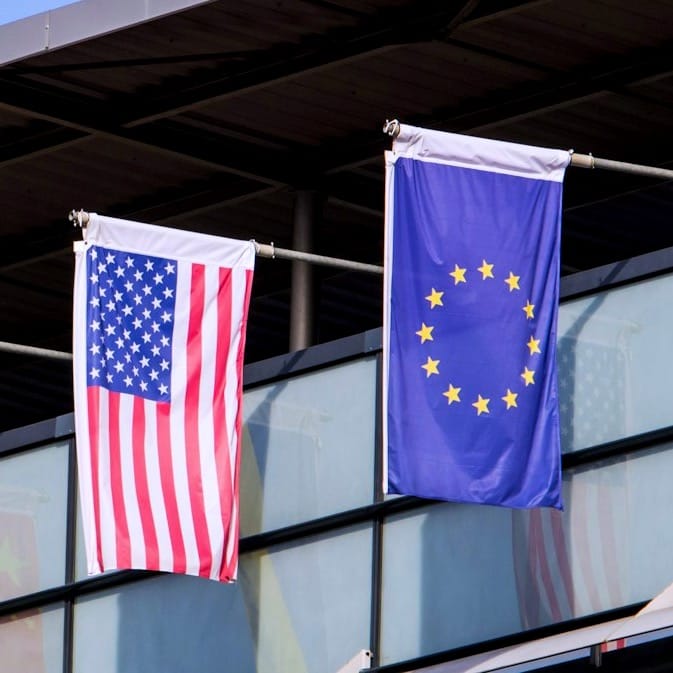
“Free speech” narratives against the EU's legislative framework for digital policy often prompt a knee-jerk reaction in Europe: “This is our land, our Union, our laws, follow them, or leave the EU - we’ll find alternative products to use!” - that’s the most typical reaction from some Europeans when they hear Americans talk about the EU’s digital rules.
Let’s be clear: the general European public cares about American constitutional amendments about as much as Americans care about European acts and regulations - very little.
And since global cooperation on emerging-technology regulation is more about diplomatic conversations, resolutions, and paperwork than real collaboration, and all of the previous attempts to establish some type of dialogue have essentially failed.
Both sides of the Atlantic are stuck in a back-and-forth cycle, where attempts to normalise the conversation (such as the EU-US trade deal) are ruined every few months by those who want to see Europe and the US further apart, not closer together.
Understanding both sides
Understanding the American perspective is not difficult.
Since social media platforms are built to have a globally universal user experience, whatever legislation is adopted in the EU will eventually change the design and functioning of global social media platforms and, therefore, also influence the “American right to exercise free speech”.
Couple that with the European Union reiterating its ambition to shape the global regulatory picture through the “Brussels effect”, the American trade surplus with the EU in services, the ambiguity of some EU digital rules (leaving the industry at constant regulatory twilight), the American technological competition with China, and the American hyperfocus on the European digital rules becomes understandable.
Europeans also have a point: a 450-million-consumer market has the right to define rules that reflect local principles, values, and needs. That doesn't mean the status quo cannot be questioned, and the Europeans who disagree with the course of action when it comes to digital rules are traitors.
Change, even if the need for it is acknowledged, isn’t easy in Europe. The European Commission, and the handful of politicians arguing for scaling back regulation and exercising “regulatory self-restraint”, are stuck between a rock and a hard place.
Even incremental attempts to simplify rules or remove regulatory overlaps are often met with hostility and personal attacks. This is in part due to different political views, and in part because Europe’s regulatory machine tends to create lawyer, consultant, and expert classes (if not entire industries) that live off those regulations and are ready to defend them with all their might.
To be completely fair, some American public figures are also shooting themselves in the foot by engaging in broadly anti-EU rhetoric, which only drowns out European moderates and prompts knee-jerk reactions from others in Europe.
Zooming out
The past two years have been difficult for moderates on both sides of the Atlantic, where discussions based on mutual interests and partnerships are overshadowed by grandiose statements and negativity.
The most logical course of action at the moment is to think long-term - zoom out to assess the EU-US tech partnership in the context of partnerships between, say, China and Russia, and to take any grandiose statements with a grain of salt.
Neither we Europeans nor the Americans live in a vacuum, and both sides will eventually lose more if the tangible dialogue is postponed even further: the global economy is interconnected, blank-slate decoupling is unrealistic, and the rest of the world is watching - and sometimes benefiting from transatlantic infighting.